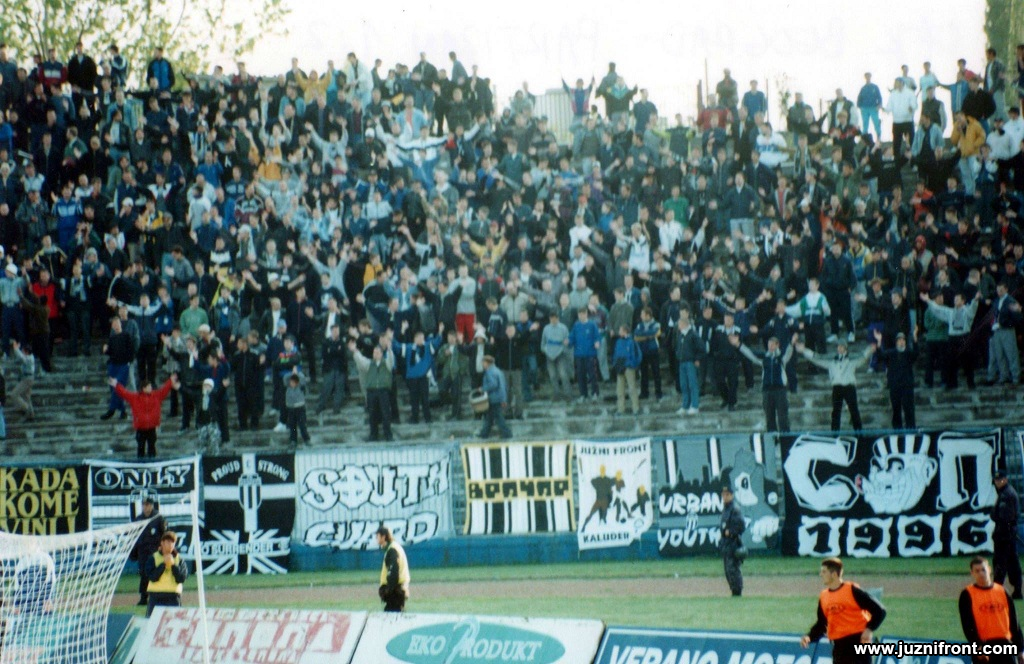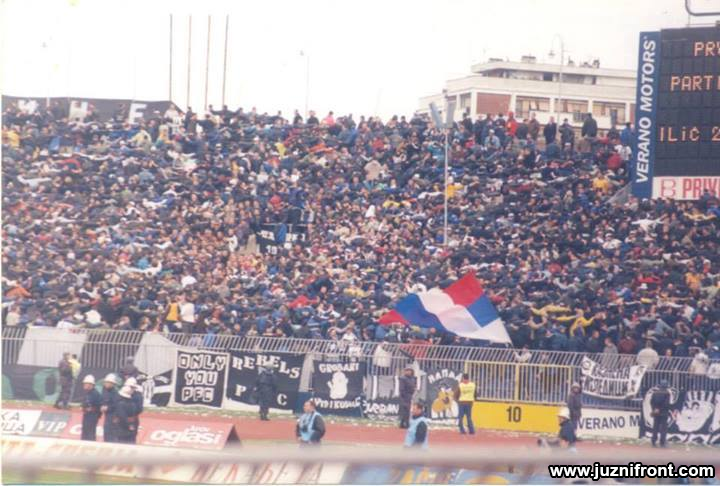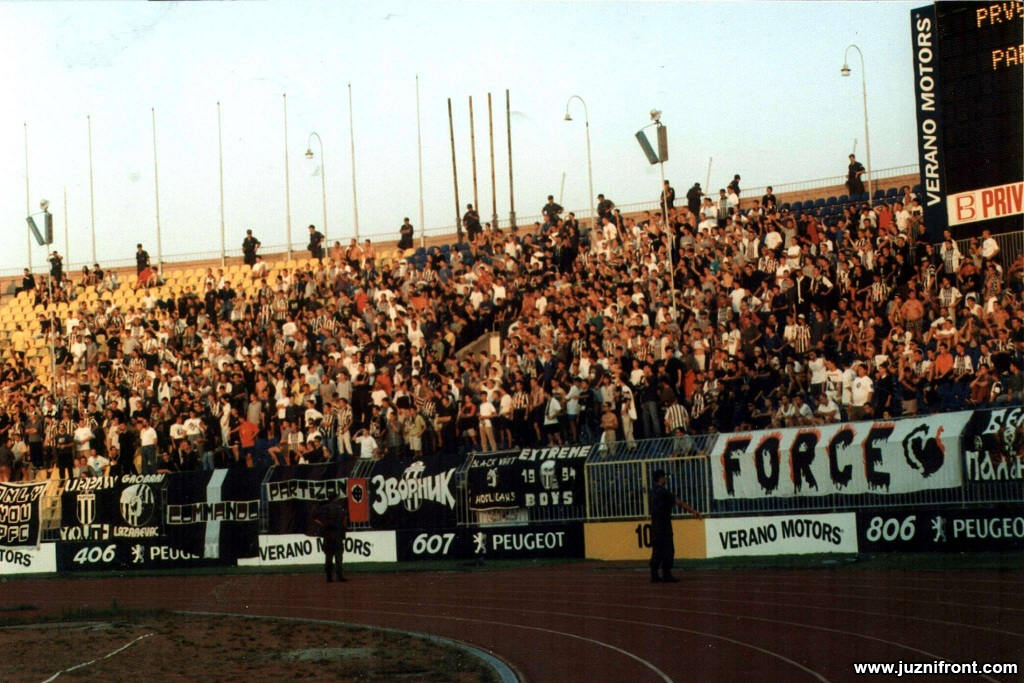
History of Gravediggers (Grobari Beograd)

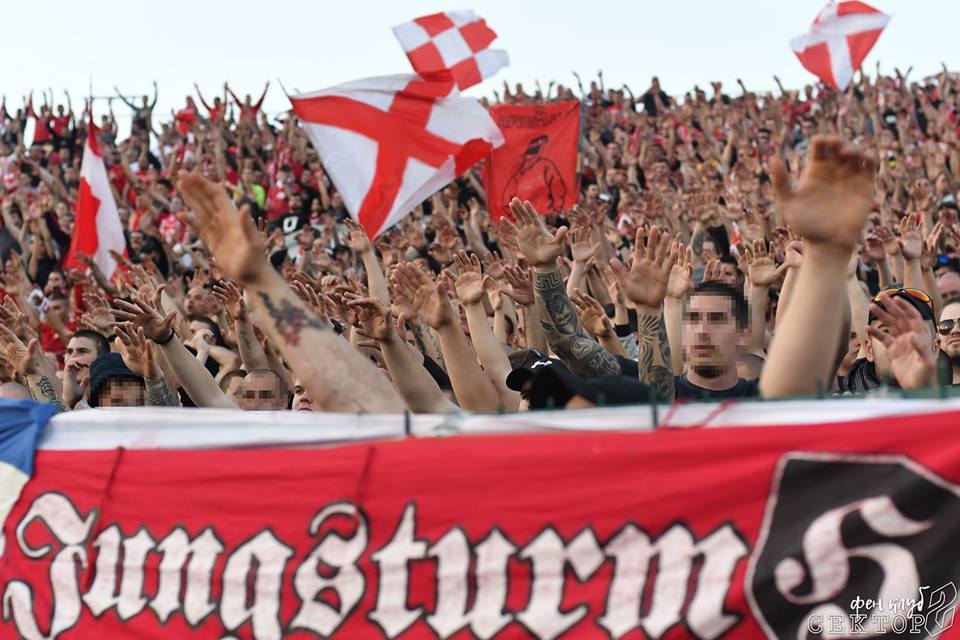
The beginning of Grobari movement as a supporters group is closely associated with the year 1945. Simultaneously with newly-founded Football Club Partizan, its birth is followed with the inception of its first supporters groups

The beginning of Grobari movement as a supporters group is closely associated with the year 1945. Simultaneously with newly-founded Football Club Partizan, its birth is followed with the inception of its first supporters groups. However, the beginning of 1950s saw the first proper groups of Grobari. Guys from Cukarica, Rakovica, Senjak and Topcider (parts of Belgrade) started gathering at the northern side of the JNA stadium, and the rest of the city parts occupied the southern side.

End of 1950s and the beginning of 1960s witnesses the first supporter’s flags, as well as the tendency for group gatherings at certain city places. The 1970s witnessed the expansion of the supporters group and the numerous novelties introduced, as the first songs, large flags … and the ‘official’ acceptance of Grobari/Gravediggers as the name for Partizan’s most loyal and staunchly followers. These years can be marked as the ‘birth’ of Grobari as an organized supporters group, group that devoted its life to the Partizan and its glory. Allegiance and devotion was confirmed with each of the game, even when Club was facing the slump of results. Even than, large crowd was to be seen on each of the Club’s games, supporting Partizan and its players, giving fanatical support and love to the Club … unconditionally!

Visits to Nis, Novi Sad, Ljubljana… where huge number of supporters stood by their Club, filled the stadiums and in innumerous times proved its name and reputation, today are with pride and fervor spoken and taught to younger generations, the ones who recently entered the South side and are to become the future vigor of Grobari. The famous reputation as the most faithful supporters group Grobari ‘deserved’ after the game against Hajduk Split, played in 1976. That day witnessed something unbelievable and extraordinary happening at the JNA stadium. Losing 1-6 against its arch-rival did not shake the spirit, love and energy of each and every Grobar present at the stadium. Once again, they managed to stay great even when their club faced a terrible outcome. The amazing roar spread throughout the stadium … without stopping the song of Grobari kept rising and rising … and when Partizan scored its only goal that evening, the JNA stadium ‘exploded’ like a volcano. End of the game, 1-6, and still … tremendous ovations, song and applause for our players. From that day, the unique ‘bond’ was found between players and supporters of Partizan, lasting throughout the years.

Coming years marked the total domination of Grobari, their superiority against other supporters groups and the expansion of the group, in its number, organization and actions. Eighties! It was the period which witnessed the new generation of Grobari on the scene. Young, tough and full of never-ending energy, they brought new imagination and style to the Grobari movement. They saw each and every game as a chance to prove their faithfulness, their might and craziness. In large groups, they followed Partizan everywhere. Every time, every new game away was another little ‘war’ to them, where they eagerly waited for confrontation with the opposite side. Simply, it was a pure avante garde of that time, a prototype of everything that will be the symbol and trademark of the ultra supporter group, throughout the football world. Each and every city, place, stadium … fully and clearly remembers Kaznena Ekspedicija (Punishment Expedition). Its slogan: Do groba uz Partizan (With Partizan to the Grave) … was attested and reinforced in each and every situation. Their domination lasted for many years, and what’s even more remarkable is that this generation never really left the kop. The title and character of the most loyal and extreme fan organization was impressively built right through this period. The one quality crucial to this appearance was the unique ‘inner craziness’ that was possessed by each and every Grobar, each of them ‘infected’ by the energy and spirit found at the South side.

That specific way of support, opposite to all the typical and traditional of that time, culminated in the early 1980s with the new generation present. It brought to the fore the rule “It’s important to be the craziest!” At the stand, the madness was explored through anarchical yet very loud way of support … and final result mirrored in the ‘viciousness’, followed by a famous English song “Here We Go” (South incorrectly interpreted this as “Every Go”). Together with the already famous fanaticism and unlimited devotion to the black-white colours, this contributed to the fact that their greatest moments happened when Partizan faced hardest moments at the pitch.

Outside the stadium, ‘madness’ resulted in great range of supporters-hooligans’ accomplishments, something that other domestic supporters groups could only dream about. Captivation of the supporters from Split in the ‘Palas’ hotel (1981), destroyed city of Vinkovci (together with the residents of the same, 1982/83), “supporters night of terror” in Sid (1985), demolished stadium in maksimir – Zagreb (1990), fight at the marakana pitch with old customers, gypsies (we know what they get as OUR customers) … are some of the situations that proved the correctness of the slogan “Mi smo Grobari, najjaci smo, najjaci!” (We are Grobari, we are the strongest!). This irrational, ‘mad’ moment so recognizable to Grobari, as the greatest and most devoted supporters … was often an obstacle to some more organized ways of support (like large choreography at the stadium).

Yet, the vociferous scream, in innumerous situations melted everything and everybody facing Partizan, carrying the team to amazing triumphs: remember the return leg against QPR (May 1984), game against Dinamo (May 1983) when Partizan thanks to Grobari reached for the league title (2:2 at the end after 0:2 at the half time). Or else the 20 minute ‘eruption’ of South side in one of the city derbies (1990s). The ambiance before, during and after all these games, in which Grobari were writing the history…with their voices, hands, often fists! The history epitomized in one sentence “Only Grobari can do that!
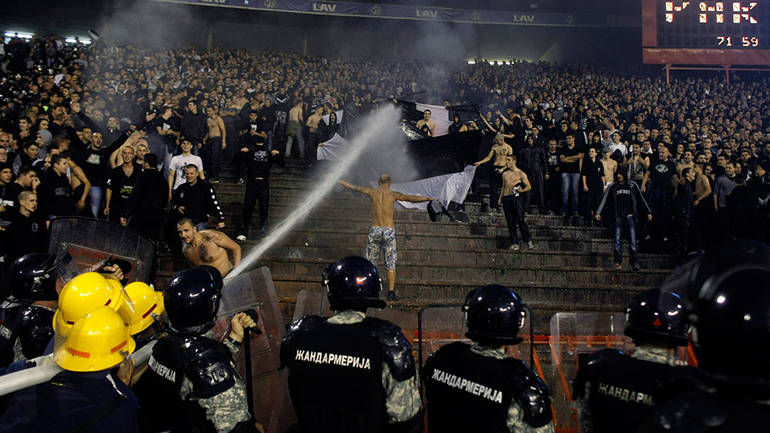
 

After a short break, new generations of the nineties, with open guard and huge enthusiasm, followed the ‘footsteps of fame’ of their older ‘comrades’. However, the destruction of Yugoslavia limited the space and opportunity to prove their prominence and supremacy in the ultra-fan world.

After a short break, new generations of the nineties, with open guard and huge enthusiasm, followed the ‘footsteps of fame’ of their older ‘comrades’. However, the destruction of Yugoslavia limited the space and opportunity to prove their prominence and supremacy in the ultra-fan world. The nineties brought to the fore the new generation of Grobari, which followed the way described crudely as ‘With Partizan to the Grave’. The war years did unfortunately claimed its price, impeding the group to express all its greatness, as well as the fact that a great number of Grobari went to war following some higher ideals and believes. They returned full of bitterness and remorse, being betrayed and disappointed with that they went through and what they encountered in their struggle.Some of our brothers never returned, and are forever remembered by their Grobari brothers.

After the end of the war period, new generations starting to fill the South side of the stadium. With same zeal, they followed the Club and provided important energy for the group’s expansion. This was achieved within the environment in which Club faced terrible spell of results, while the structure of the Club was further weakened by the disastrous handling of the Club’s affairs by the current management. Yet, the love for the Club could not be dented, which was demonstrated in numerous times … in each game that Partizan played, in every street, stand or city where Grobari faced the opposition … Yet … The weakening of the domestic league, economic hardship and social tensions all influenced the decrease in number of people following the Club, the ones ready to be there and support the team in each encounter. However, the energy and zeal clearly possessed within the group injected the new lease of life to Grobari.

Those years marked the total domination of Grobari when basketball games are in question, often portrayed as the best and the most loyal basketball audience. If we can agree that football games against Hajduk (1976) and QPR (1984) are the Bibles of Grobari movement, I will dare to add the game against Maccabi (Israel) as the basketball’s equivalent. Losing the game, and losing heavily (the difference was 20 points), triggered the craziness and affection for the Club so typical and unique for Grobari. The mad song and support, which relentlessly continued for 30 minutes after the conclusion of the match, forced the players to return twice from their changing rooms and bow to something so rare in today’s sport.
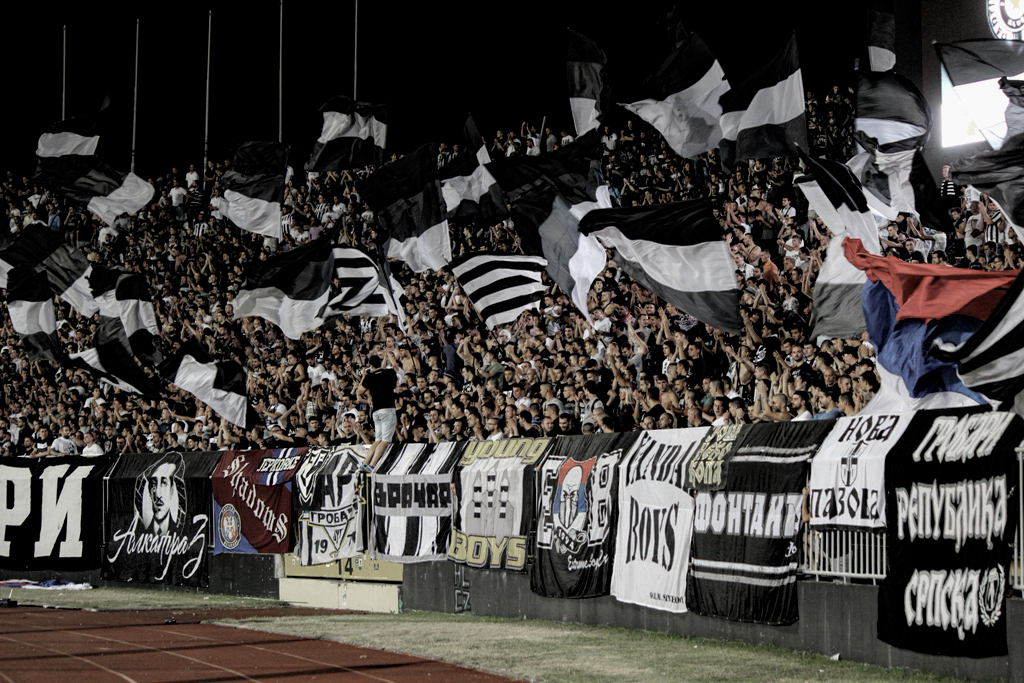
 

The wins were achieved in many derbies, where we faced our greatest rival. In those years, the game witnessed the South side covered in enemy’s flags and banners, taken in direct confrontations before the matches. As well, the song and support from the South continuously blew away the song coming from the opposite side. Still, the years proceeding witnessed the darkest period in the history of Grobari.

The constant attempts of the FC’s management to divide supporters, turn them against each other … finally produced results. They tossed the seed of hostility, hoping that through the supporters’ disunity they can grip the only force able to dismantle the criminal structure within the Club … Grobari. Already in that moment, the diverse character of the group brought to the front two fractions of Grobari … the younger and more extreme one, founded within the South Front fraction (established in 1999) and the part of the group mainly consisting of older Grobari. The South Front stressed its principles calling for completely independent and self-supported organization, a definite break from the management’s grip and support. The older Grobari, many of them well-known legends within the movement, thought that the future will be brighter if the links are preserved.

The seed of discord was there, only to influence the complete confrontation between two sides. South Front, the large section of Partizan’s supporters, stopped its attendance of the games and influenced many young and urban fans, future foundation of Grobari. One and all saw this as the calamity, all but the Club’s management, who was now free to pursue its financial mismanagement and obliteration of the Club. Three years passed … South Front standing on the other side, separated in every way from the rest of Grobari, who continued its support from the South side (numbers drastically and continuously decreasing in each and every game).

Grobari realized that the group cannot function in such manner, that future and existence of Grobari as the organized supporters group is in question … and once again brothers stood by next to each other, again united, again as one, strong and proud. South was once again the melting-pot of all that Grobari represent, their love, honor and devotion, with new fanaticism and devotion brought about by the positive developments. The expansion once again became order of the day for Grobari.

The first half of the season witnessed some awesome displays of support for black-white colours, games in which Grobari showed that the greatness is still there, indestructible. Yet, the rotten within the Club perceived this as threat, and our new vigor compelled them to go for the final blow to the group. The result…everything that is a part of the supporters way of life and action, allowed everywhere in the sport’s world, was denied to Grobari. No banners, flags, drums were acceptable whatsoever, the pyrotechnics could be just dreamt of. Yet, our prominence was shown once again! Facing the offensive, hassle and restrictions, Grobari managed to put the onslaught aside and for the sake of the Club (who aimed for the Champions League) give their total support to the team in these critical games. As always, our commitment and dedication failed to find the reciprocity within the Club, once again betraying all agreed before.
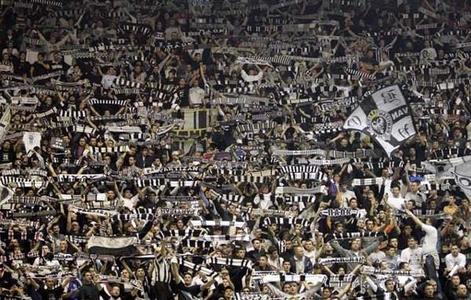
The final decision was made, which placed Grobari on the road for their greatest struggle … boycott of the Club’s management and all the FC’ games. The demands of our protest listed the removal of the Club’s management, with no exceptions whatsoever and no delay. Twenty years of the systematic annihilation of the Club are still not sufficient for the gang who perceive the Club merely as the lucrative business for themselves and their personal accounts. The boycott was a natural outcome, combined with the massive protests outside the stadium. Again, Grobari achieved something that no group from here managed … the whole season we stayed away from the football games, and managed to keep the South stand empty in all the matches played. This feat was maintained even in the great derby against red star, act which proved the support for our cause as well as the commitment and loyalty of each and every Grobar.

The organized support continued in other sports, supporting our Club in its attempts for trophies. Our long and celebrated history never witnessed more difficult task facing the Grobari movement. The task and mission to eliminate the rotten from our only Club…today when we are far away from our stand yet so much with the Club. The task that we all believe will be achieved, sooner or later. Once again, the song and roar will spread from the South side, the army of faithful supporters returning to the place so sacred to them. Ready to give everything for the Club, their devotion is the pledge for the ultimate triumph in this fight.
Medjusobna tuca policajaca zbog navijaca

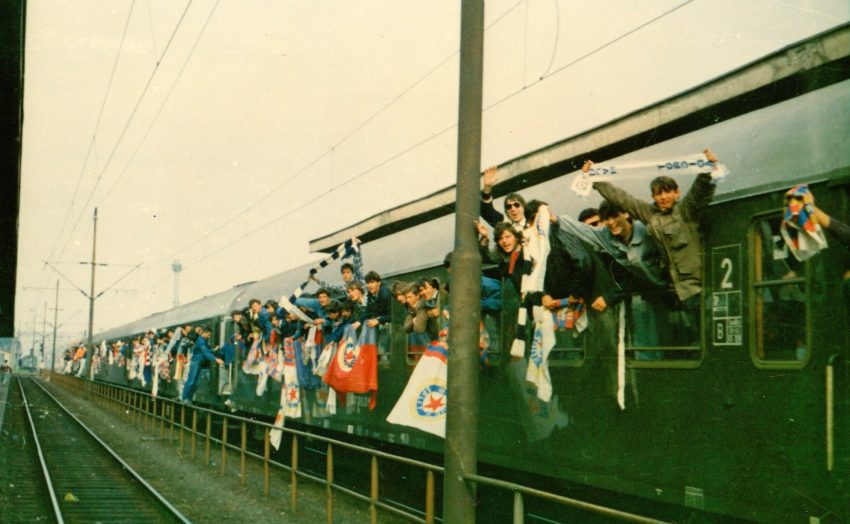
Vraćali smo se vlakom iz Zagreba s derbija, bilo je to početkom devedesetih, i u jednom trenutku je zagrebački specijalac ošamario navijača Hajduka bez ikakvog razloga. Momak je samo ulazio u vlak na zagrebačkom kolodvoru, a on mu je prilijepio plesku. U to vrijeme navijače Hajduka na putu za Zagreb bi pratili policajci iz Splita kao vlakopratnja. Jedan od njih, kada je vidio tu scenu, prišao je zagrebačkom kolegi i pitao ga zašto je udario momka. On mu je odbrusio da se ‘vrati dolje u provinciju'… Splitski policajac, mislim da je bio neki Makaranin, sjećam se samo da je bio ćelav, udario je ‘purgera’, a ovaj mu je potom vratio! Nastala je nevjerojatna scena: s jedne strane su se zaletjeli splitski policajci, s druge zagrebački i nastala je tučnjava na kolodvoru! Nismo mogli vjerovati… – prepričava Boris.

– Bilo je to prvi put da sam navijao za policajce! – dodao je njegov prijatelj.

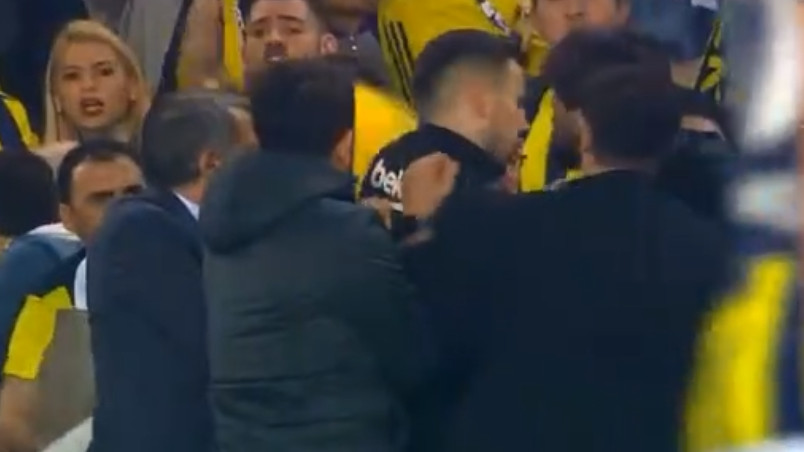
Potpuni haos u turskom derbiju: Pogođen trener Bešiktaša, golman krenuo na navijače

Meč polufinala Kupa Turske između Fenerbahčea i Bešiktaša donio je nemile scene na terenu i tribinama.

Nakon desetak minuta igre u drugom poluvremenu došlo je do prekida duela, a meč su prekinuli navijači Fenerbahčea.

Oni su tokom meča konstantno gađali igrače Bešiktaša, a sve je kulminiralo početkom drugog poluvremena kada je pogođen trener gostiju Šenol Guneš.

Njega su navijači Fenera pogodili predmetom u glavu, ali ni to nije bilo sve. Rezervni golman Tolga Zengin je krenuo na tribine da se obračuna sa navijačima, nakon čega je sa tribina počelo da leti sve i svašta.

Nakon svega su se igrači Bešiktaša povukli sa terena.

(sportsport.ba)

URBAN YOUTH (tekst iz 2000. godine)

Jedna od trenutno najmladjih ekipa članica “Južnog Fronta”, čije vreme tek dolazi, rešila je da vam se predstavi i na ovaj način.

30.10.1999.
Par momaka iz Mirijeva došlo je na ideju da prekine “vladavinu” cigana u ovom kraju. U početku nas je bilo veoma malo, ali se ipak, kako je vreme odmicalo, broj sve više povećavao. Prva tekma na koju smo prvi put organizovano otišli je bila ona sa ciganima na našem stadionu kada smo ih razbili 2:0! Kao i svaki početak i ovaj je bio težak jer su se ciganšture opasno nameračile na nas, jer su utripovali da je Mirijevo samo njihovo(!!?).

Prvobitni naziv ove ekipe bio je “Budale PFC”, a čak je bila uradjena i velika zastava, ali zbog nerazumevanja pubova nismo mogli da je unosimo na tekme. No dobro. I pored tih sranja nastavljeno je da se ide na tekme sa tim što je odlučeno da promenimo ime, što zbog stvaranja ozbiljne grupe, što zbog kerova. Nakon nekoliko rešenja i uz malu pomoć Dušana Mihajlovića odlučeno je da novi naziv bude URBAN YOUTH. Posle par meseci naša zastava je krasila ogradu ispod kopa, ali ne tako često jer kako kaže pub: “Ajde ovo “urban”, ali ovo “youth” je na engleskom” (opšti smeh!!). Takodje je uradjena još jedna zastava, isto manjih dimenzija, koja se trenutno ne može porediti ni sa jednom na Jugu (slika ispod i iznad ovog pasusa).


U prvoj godini postojanja bilo je par dobro izvedenih akcija nad ciganima, a neke akcije su još uvek u planu. Što se tiče materijala uradjene su dve serije majici, članske karte, nalepnice i dve vrste bar šalova (sa vezom Urban Youth Belgrade) a za koji mesec biće i dukseri i veliki barjaci (inače ni jedna ekipa na Jugu nema svoje barjake, tako da se uvek trudimo da budemo prvi u svemu). Ostali marketing je u planu, ali zbog nemanja love to malo sporije ide. U Mirijevu je uradjen i odličan grafit sa natpisom naše ekipe koji takodje može da se vidi i u fanzinu “Grobari” br.2.


Prosek godina ove ekipe je 17 i po god. Skoro da nema ekipe koja je došla u Bgd, a da nije otišla polupanih stakala na autobusima u zadnjih godinu dana, a sve to je išlo totalno opušteno. Što se tiče brojnosti ekipu čini 30 momaka mada nas ide redovno jedno 20. Ima nas skoro u svim krajevima od Mirijeva, Konjarnika, Novog Beograda pa sve do Resnika.

Ekipa se još uvek dokazuje tako da cigani treba da znaju šta ih očekuje od ove ekipe koja je trenutno u ekspanziji.

Preuzeto sa: http://www.grobari.info

NJEMAČKA: Masovna tuča navijača Schalkea i Franfurta

Sinošnjom utakmicom Frankfurt je pobjedom od 0:1 na gostovanju protiv Schalkea osigurao prolazak u finale Kupa Njemačke.

Međutim, utakmicu su obilježili incidenti na tribinama, tačnije masovna tučnjava navijača sva suparnička tima.

Pogledajte o čemu se radi:

Interview with Russian hooligans

MOSCOW — Holding on to the ankles of two of his opponents, Alex, a 33-year-old member of a Moscow soccer hooligan group, felt the blows on his head but wouldn’t let go. The third man on top of him was battering his skull with both fists, but still Alex held on, hoping to buy his teammates, battling around him, breathing space. At last, the man rammed his elbow down into Alex’s face, shattering his eye socket. He let go.

This was not his first fight; years of organized brawls have left Alex with a face reshaped by blows. (Surgery and a plastic implant stabilized his eye after this most recent one.) And that last fight, nearly a year ago, had been a good one, Alex said in a recent interview. His side had won.

What had unnerved him was a new feeling: He realized it was getting harder to keep up.

When it first appeared in the 1990s, hooliganism in Russian soccer modeled itself heavily on the English version, adopting its clothes and terminology, including the term for its groups: firms. The Russians also embraced the English’s passion for blackout drinking and drunken brawling.

“The English were our school,” said Yevgeny Malinkin, a fan in his 40s known as Kril. “Now we’ve lost our fathers. We’ve overtaken them.”

In fact, Russia’s hooligan scene has undergone a transformation. The new generation bears little resemblance to the beery bravado and off-balance punch-ups associated with traditional European hooliganism, or even the sometimes militialike violence of South American ultras.

Instead, the fans who have emerged in Russia over the past decade are obsessed with physical fitness, elite martial arts training and — at least while fighting — militant sobriety. Christened Okolofutbola, or “around football,” Russia’s hooligan scene has developed into perhaps Europe’s toughest, and just over a year before their country hosts soccer’s World Cup, the most hard-core Russian fans may be in the best fighting shape of their lives.

But while their prowess is not in doubt, fan monitors, soccer officials and even the hooligans themselves say there is virtually no chance the disorder that the Russian fans brought to last year’s European Championship in France will be repeated on home soil.

Instead, Russia’s hooligan groups are enduring an unprecedented crackdown by the authorities, who are determined that the World Cup will go smoothly. Interviews with more than a dozen fans and hooligan group members over the past five months have shed light on a wave of arrests and searches that have targeted the most violent fans and their leaders, as the police have turned measures more associated with antiterrorism operations and political repression against the hooligans.

“Believe me,” said Andrei Malosolov, a soccer journalist who helped found Russia’s national supporters club, “the years before the 2018 World Cup will be the quietest in the history of Russian soccer.”

Battle-Ready

In Marseille in June, it quickly became clear the Russians had come to fight.

Thousands of English fans had packed the Old Port of the southern French city ahead of their team’s match against Russia at the European Championship. The English — many of whom had been drinking for three days — had occupied the waterfront’s cafes, from where some occasionally lobbed objects toward French riot police officers standing watch.

The Russians, meanwhile, had landed in Barcelona, Spain. There they boarded buses for France, identifying one another by singing Russian punk songs. Arriving in Marseille, they received text messages with instructions on where to gather. Without even stopping to drop their luggage, most headed straight for the English.

“We literally hadn’t managed to get to the end of the first beer before a clap rang out and our guys shouted, ‘So, what are we doing this?’” Ivan, a wiry fan who traveled with a dozen others to France, recalled in a Moscow bar recently. “We went into that square and started to just really, just to work in all 360 degrees.”

(Ivan, like many of those interviewed who still take part in organized fights, declined to be quoted using his full name, for fear of a visit from the police.)

The Russians hit the English like a cavalry charge. In minutes, the port was a battlefield, with fans clashing under barrages of flying bottles and pinwheeling chairs. About 200 Russian fans, many wearing masks and mixed-martial-arts fighting gloves, loped through the chaos, capturing their actions on GoPro cameras strapped to their bodies.

The violence continued in the stadium that night, when hundreds of English fans and neutrals were forced to scramble away from another Russian charge. The chaos left 35 people injured. While the English also had clashed with the police, resulting in a half-dozen arrests, most observers were transfixed by the Russians’ more efficient violence.

The Marseille prosecutor, Brice Robin, described the Russians in almost military terms, telling reporters that they were “well trained” and “ready for hyper-rapid, hyperviolent operations.” The French police expelled 50 Russians — at least one fan leader sneaked back into the country and had to be deported a second time — and European soccer’s governing body, UEFA, fined Russia’s federation $170,000 and issued a suspended threat of disqualification for its team.

Hanging over the entire episode, though, was a frightening new question: Would visiting fans risk attack from crack squads of hypertrained hooligans at next year’s World Cup? That some state news media outlets and government officials in Russia appeared to encourage, or at least condone, the violence sowed further doubt.

“The Russian fans are different,” said Antoine Boutonnet, the head of the French police’s national hooligan division. “It’s almost paramilitary.”

Training in the Woods

“I see the new generation, and I’m really surprised,” said Elena Bykova, a producer who made a film with an-all hooligan cast. “They don’t like drugs, alcohol. They’re all in the gym.”

The fans’ evolution tracks larger movements in Russian society. A trend toward martial arts and fitness generally — partly promoted by the Kremlin and President Vladimir V. Putin, a trained judoka who is proud of his sporting image — has spread to fan circles. At the same time, Russia’s security state has reasserted itself, driving hooligan violence underground.

While crowd trouble still occurs regularly at Russian league matches, at least a decade ago the authorities’ aggressive policing and closed-circuit cameras largely forced the most dedicated elements of Russian hooliganism to go, as the fans say, “into the woods.”

in the Gym

On a recent evening, two dozen young men gathered in a stylish Moscow gym. Wearing skull masks to shield their faces, they went through a warm-up before fighting practice bouts in boxing and wrestling.

“It’s all on a different level now,” said Yevgeny Berezin, who led the session. Berezin fought in organized brawls for 10 years but recently stopped, he said, to focus on acting.

The hooligan firms are now effectively underground fight clubs. Older fighters — usually only in their late 30s or early 40s — lament that many fighters are uninterested in soccer; one joked that stadium bans won’t work in Russia “because our fans don’t go to the football.”

The participants are diverse — construction workers, information technology managers, fitness trainers — but the most active consider themselves elite fighters with an honor code. They insist they would never attack ordinary fans, only other hooligans.

“Why beat up ordinary people?” Alex said. “It’s not interesting. It’s not fair.”

He and others attributed the attacks on the English in Marseille to overenthusiasm, noting that the Russian fans there were not from top firms — they were young regional groups at their first big tournament.

“There are some who like to drink and break stools over people’s heads,” Berezin said. “But that has nothing to do with Okolofutbola. That’s just some kind of hooligans.”

Particular pride is taken in fighting exclusively bare-knuckle. Ultratrained hooligans have appeared in other countries — notably Poland and Germany — but only in Russia is it seen as having become entwined with the national character. Its supporters also point to the similarities of the fights in the woods to an old peasant game known as stenka na stenku, in which two villages would square off during festivals.

For some, organized hooliganism has become a sort of primal expression of uninhibited Russian masculinity, and it appears peculiarly suited to a moment when the Kremlin is cultivating the idea that Russia must rely on its strength alone in its opposition to a bloodless, overcivilized Europe.

After Marseille, Putin himself wondered aloud how “200 Russians could thrash several thousand English.” It was perhaps this context that led to an unlikely proposal recently by a Russian politician to make hooliganism a sport.

“Given our fans are fighters, not hooligans,” the politician, Igor Lebedev, a member of the Liberal Democratic Party and of Russia’s national soccer association, wrote on his website, “we can turn fans’ fights into a sport! Introduce rules, team competitions.”

Lebedev’s proposal prompted horror in Europe, but it perhaps more reflected an increasing government effort to separate Russia’s hooligan scene from soccer.

Last spring, a brawl between Moscow’s two top firms resulted in house arrest for five fans, including a firm leader. The men face jail time — an unusually harsh punishment for such a fight.

The arrests spooked the fighters, as more detentions followed, as well as frequent searches of fans’ homes. Fans interviewed by The New York Times talked of receiving visits from armed police officers, and of telephone calls warning them that they are being watched.

In September, Russia’s national supporters’ club, which represents fans, was shut down, while its chief, Aleksandr Shprygin, was arrested and briefly held in connection with the same brawl. The next day, Shprygin’s car was set afire by arsonists. The closing of the fan club, which presaged Shprygin’s arrest and arson attack, was viewed as a punishment for his championing the Russian fan violence at the European Championship in France.

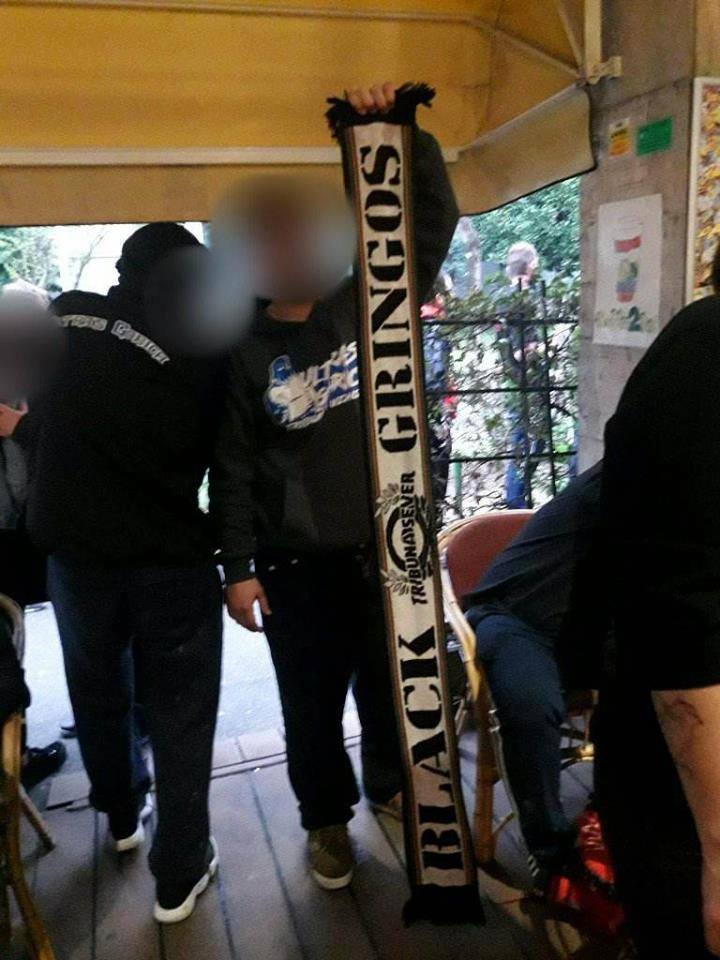
Terror Boys napali Black Gringose na gostovanju u Goriskim Brdima (VIDEO)

Slovenija nije cuvena po velikim rivalitetima izmedju navijackih grupa i sigurno je rivalstvo izmedju Green Dragonsa i Viola iz Maribora najpoznatije u najsevernijoj zemlji bivse SFRJ. Osim ovog rivalstva u Sloveniji postoji jos jedno koje datira poslednjih 20-ak godina uglavnom u nizim ligama i ono je izmedju Terror Boys-a iz N. Gorice i Black Gringosa iz Murske Sobote. Posto ove dve ekipe nisu u istoj ligi i nisu imali priliku da se sastanu ove sezone Terror Boys su odlucili da napadnu Black Gringose kada su navijaci Mure gostovali u blizini Gorice tj u Goriskim Brdima koja su udaljena oko 20 km od Nove Gorice. Iako im je krajnji cilj bio da se dokopaju zastava Black Gringosa goricani su morali da se zadovolje oduzimanjem jednog sala.


Ovo je jos jedan u nizu sukoba ovih grupa koje su se dogodili 2004. i 2011. godine kada su se desili incidenti tokom i posle utakmica.


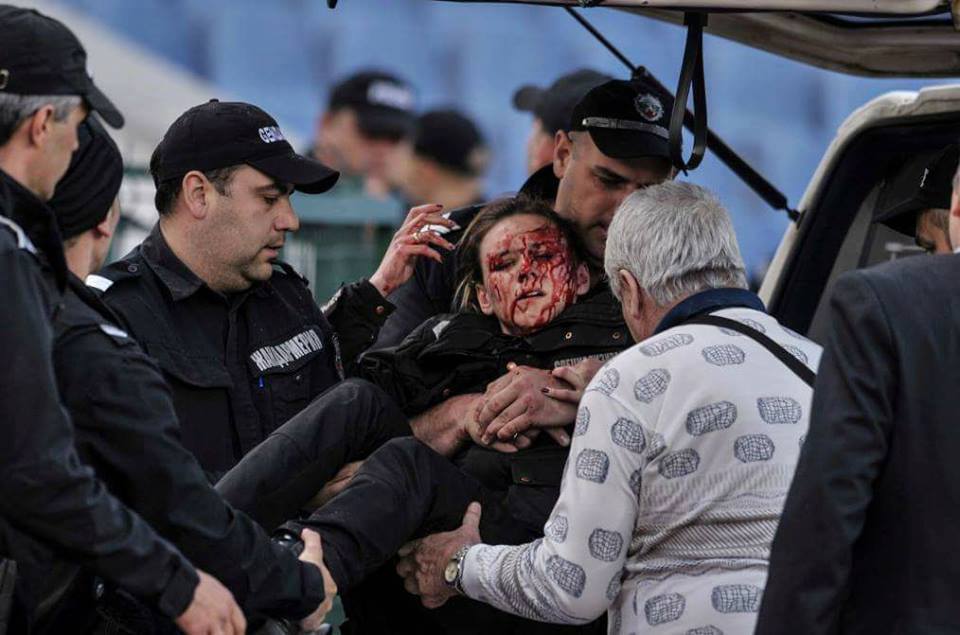
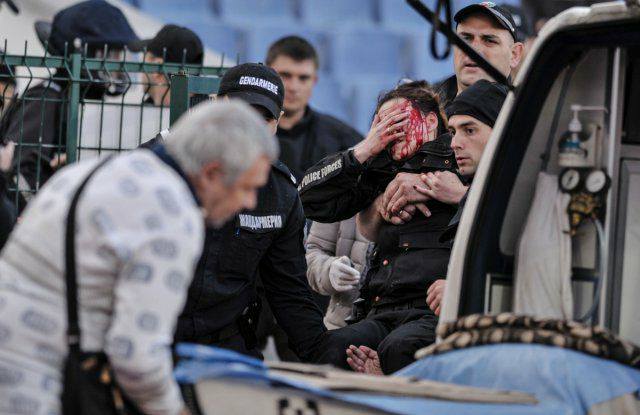
Navijaci Levskog bacili bombu na policiju

Deset navijaca Levskog iz Sofije zadrzano je u pritvoru zbog sumnje da su bacili bombu kucne izrade na danasnjem derbiju, bomba je pala u blizini policajke koja je u ovom incidentu zadobila teske povrede. Zrtva je prevezena u klinicki centar i doktori se bore da joj spasu oko koje je najteze povredjeno. Incident se dogodio na stadionu Vasil Levski gde se odigrao veliki Bugarski derbi izmedju domaceg Levskog i gradskog rivala CSKA. Pored policajke jos nekoliko osoba je povredjeno ali povrede su na svu srecu lakse prirode.


Iako je rezultat utakmice ostao u drugom planu napomenucemo da su ekipe remizirale 2:2

Prica o Dugopolju i ostalim sukobima Torcide i BBB

Išli smo sa sedam auta iz Splita. Ponili smo sve šta triba: bejzbol palice, letve, šipke, benzin. Imali smo svog čovika na punktu i on nam je mobitelom javija da su se četri auta zagrebačkih tablica izdvojila. Napravili smo “čeku”, opkolili ih i…udri. To im je za oni kombi od zadnjeg puta
Igrom slučaja, u subotu navečer zatekao sam se u jednom splitskom kafiću (nije bitno kojem) punom torcidaša koji su slavili pobjedu nad Dinamom. Igrom slučaja, među njima je bila i nekolicina “komandosa” koji su se nedugo prije toga vratili iz “akcije Dugopolje”. Moram priznati, ispočetka nisam vjerovao što mi pričaju.
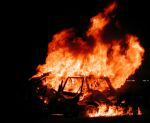
– Zapalili smo ih u autu, čoviče! – rekao je jedan

– Sjebali smo ih totalno, jedan je gorija! – vikao je trijumfalno drugi, već obnevidio od alkohola i adrenalina.
Kažem, u početku nisam vjerovao što mi govore ti golobradi momci, od kojih nijedan, po mojoj procjeni, nije bio stariji od 18-19 godina. Međutim, po količini detalja koje su iznosili shvatio sam da priča ne može biti izmišljena. A momci su pričali sve dok ih jedan od njih, moguće njihov lider, nije poklopio:
– Dosta priče! Nema više priče! Neću da mi panduri ujutro dođu na vrata!

Momci su ga poslušali i utihnuli. Ono što sam dotad čuo nevjerojatno mi je sličilo na neku od akcija pripadnika Legije stranaca ili kakve slične visokouvježbane i visokoorganizirane grupe komandosa. Dakle:
– Išli smo sa sedam auta iz Splita. Ponili smo sve šta nam triba: bejzbol palice, letve, šipke, baklje, benzin. Imali smo i jedan vatrogasni aparat. Napravili smo “čeku”, opkolili ih i… udri!
– Kako ste znali da će se neki navijači Dinama izdvojiti iz kolone? – pitao sam.
– Imali smo dojavu.
– Kakvu dojavu?
– Imali smo svog čovika na jednom punktu i on nam je mobitelom javija da su se četri auta zagrebačkih tablica izdvojila i da voze iza jednog kamiona. Sačekali smo kamion, pustili ga da prođe i blokirali cestu. I tu ti počinje najluđi dio. Otvaramo prvi auto, a ono unutra žena i dite: ništa, pustili ih, štaš sa njima. Otvorili drugo auto, a ono unutra tri tipa. I taman da ćemo ih izvuć iz auta, a likovi vade karte od utakmice, svi bili na “istoku”. Naši, razumiš! Pustili i njih, a ono vidiš treći i četvrti auto se okriću na cesti, tili su pobić prema Splitu. E, ali mi smo imali aute i iza njih i tako smo ih blokirali sa dvi strane. I ništa, onda smo ih izvukli iz auta, iscipelarili i zapalili auto. I taman to obavili, a ono vidiš stiže kolona purgera, rotacijska svjetla isprid i iza, pandurija razumiš, i onda smo sili u auta i nazad u Split.
Još su momci htjeli pričati, ali onda je intervenirao prije spomenuti navijač, i priča je prestala. Momci su otišli put šanka, a ja sam samo nijemo pogledao konobara koji mi je upravo donosio piće. Budući da se poznajemo s gostovanja, upitao sam ga za komentar, a on se uhvatio za glavu:
– Pizdariju su napravili, veliku! Živog čovika su zapalili! Razumin sve, al nije tribalo otić dotle.
– Ma ko im jebe mater! – dobacio je jedan od mladaca. – To im je za oni kombi od zadnjeg puta.
Radi razumijevanja priče, moramo objasniti i “slučaj kombi”. Dogodilo se to prilikom posljednjeg derbija Dinama i Hajduka u Zagrebu, odigranog krajem kolovoza, dakle prije tri mjeseca, kad je oveća skupina BBB-a na naplatnim kućicama na početku autoceste Zagreb-Karlovac čekala torcidaše koji su se vraćali s utakmice. Navijači Dinama tada su napali jedan navijački kombi Torcide, izvukli splitske navijače iz vozila, premlatili ih i opljačkali. Sve se to odigralo samo nekoliko minuta prije nego sam i sam stigao na naplatne kućice autoceste, tako da sam jasno mogao vidjeti premlaćene i opljačkane splitske navijače i njihovo oštećeno vozilo, oko kojega je zagrebačka policija upravo radila očevid. Dva-tri sata poslije stali smo u Korenici, kod “Macole”, i restoran je bio pun navijača Hajduka: glavna tema svih razgovora te noći u Korenici bila je osveta za kombi na prvom sljedećem derbiju u Splitu. Bijes torcidaša bio je pojačan činjenicom da su idućih dana zagrebački mediji uglavnom prešutjeli taj incident.
Već tada se, dakle, znalo da će se 6. prosinca u Splitu nešto dogoditi, ali malo je tko mogao vjerovati da će torcidaši otići toliko daleko i zamalo usmrtiti pun automobil navijača Dinama.
Naravno da priča o kombiju ne opravdava brutalno nasilje kojem su u subotu uvečer kod Dugopolja bili izloženi navijači Dinama: taj detalj navodim samo kao ilustraciju mehanizma koji je doveo do surove osvete splitskih navijača.
Također, te subotnje večeri, neposredno nakon utakmice, na poljudskom stadionu dogodilo se nešto što je dodatno razjarilo već ionako “nabrijane” mlade torcidaše. Naime, po završetku utakmice navijači Dinama s južne tribine iskoristili su činjenicu što su ostali sami na stadionu: preskočili su ogradu i prodrli na teren, iskidavši ili ukravši nekoliko Torcidinih transparenata izloženih na “jugu” Poljuda: TORCIDA TROGIR, TORCIDA POSUŠJE, TORCIDA BUDAPEST i TORCIDA ĐAKOVO. Torcidaši su posebno pobjesnjeli na kidanje transparenta TORCIDA ĐAKOVO, jer se radi o jednom od najstarijih, najvećih i najljepših Torcidinih transparenata, a “komandosi” koji su se zaputili u Dugopolje imali su informaciju o krađi transparenata, te je moguće i to utjecalo na brutalnost njihova čina.
Još jednom ponavljamo: ovim ne opravdavamo taj čin, već samo pokušavamo objasniti njegovu genezu.
Svakako moramo naglasiti da velika većina pripadnika Torcide, osobito onih starijih od 20 godina, žestoko osuđuju “akciju Dugopolje”. Kad sam u utorak ujutro (jučer) došao u Klub navijača, vrata su bila zaključana, ali je desetak navijača sjedilo po štekatima okolnih kafića. Atmosfera je bila teška i mučna, a njihova lica bila su smrknuta kao da je Hajduk u subotu izgubio. Naravno, nitko se nije htio predstaviti, ali svi su bili jednodušni u osudi divljačkog čina:
– Napravili su totalno sranje – rekao je jedan. – Mogu razumit da su ih izvukli iz auta i malo istukli, to bi, ka, bilo regularno, ali živog čovika zapalit, pa jebote bog, nisu normalni.

– Meni dođe da plačem od muke – procijedio je drugi.
– Idem na utakmice od 1968., proša sam s Hajdukom sve stadione, invalid sam Domovinskog rata, i sad mi dođe da plačem od muke.
– Normalno da osuđujen ovo šta su naši napravili – rekao je treći – ali ovo se moralo dogodit. Morison je prije godinu-dvi bija u komi kad su ga u Zagrebu prebili, pa nikom ništa. Malom Slavku su preklani u Zagrebu izbili oko, pa niko nije odgovara. Onda su dvojicu naših izboli nožem u tramvaju i opet niko nije odgovara. I sad jebiga, imaš to šta imaš.
– Posli ovoga ne moš se više pomirit – turobno je dobacio četvrti. – Ne moš sad otić na večeru zajedno, napit se i zapivat, i reć: “Ajmo se pomirit!” Ovo se može riješit jedino da neko dobije dvi godine zatvora.
– Najgore je šta će sad najebat naši po Zagrebu, studenti i stariji ljudi šta nemaju veze s tim – zaključio je peti.
PS: Molim pripadnike MUP-a da me ne pozivaju na obavijesne razgovore, jer nisam u mogućnosti reći ništa više od ovoga što sam napisao, pri čemu se pozivam na Zakon o informiranju.

Preuzeto sa: LUPIGA


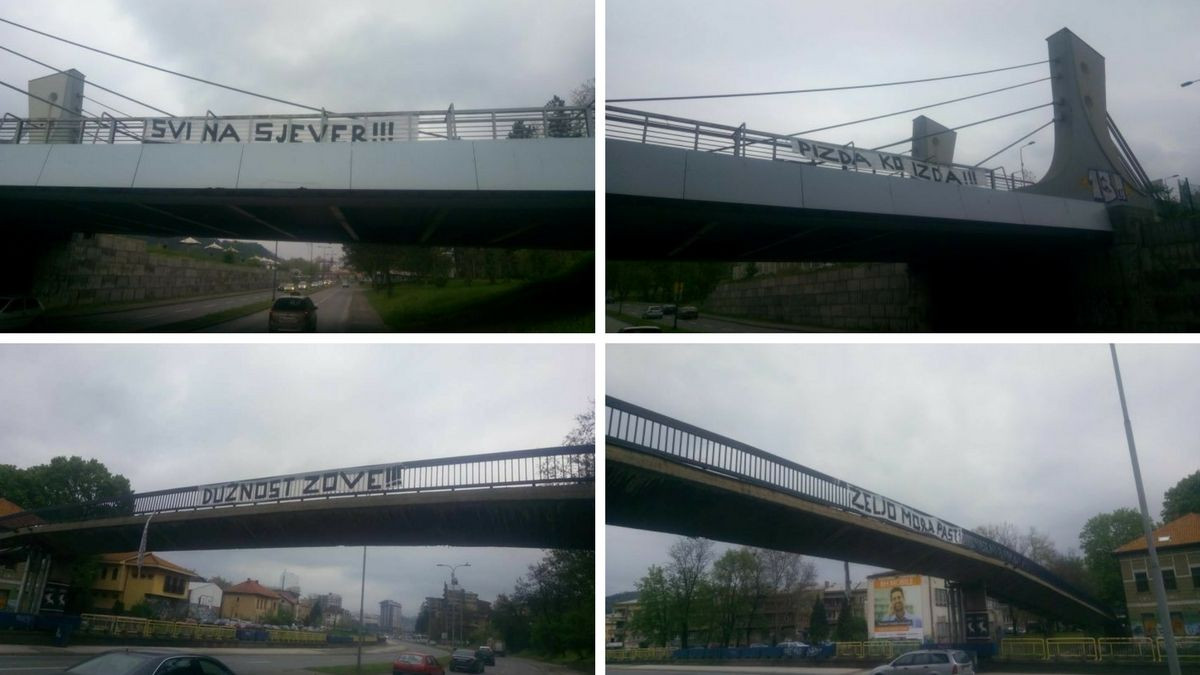
“Dužnost zove, Željo mora pasti”

Danas je veliki hype među navijačima Slobode, popularnim Fukarama. Izabranici trenera Slobode Slavka Petrovića će na Tušnju ugostiti sarajevski Željezničar, a samo jedan tim će se na kraju radovati plasmanu u finale Kupa BiH.

Fudbaleri Slobode spremno ulaze u ovaj meč. Očekuje se izuzetno žestoka borba svih igrača ovog tima, a dodatnu snagu će dobijati i sa tribina.

Najavljen je dolazak velikog broja navijača ovog tima. Stadion bi trebao biti poprilično ispunjen, a najvatreniji navijači su širom grada ostavljali parole kojima pozivaju na utakmicu.

Poruka koju su najvatreniji navijači domaćeg tima uputili je sasvim jasna: Željo danas mora pasti…

Susret Slobode i Željezničara počinje od 18 sati, a prvi duel prije sedam dana na Koševu završen je bez pobjednika 0:0.

(sportsport.ba)