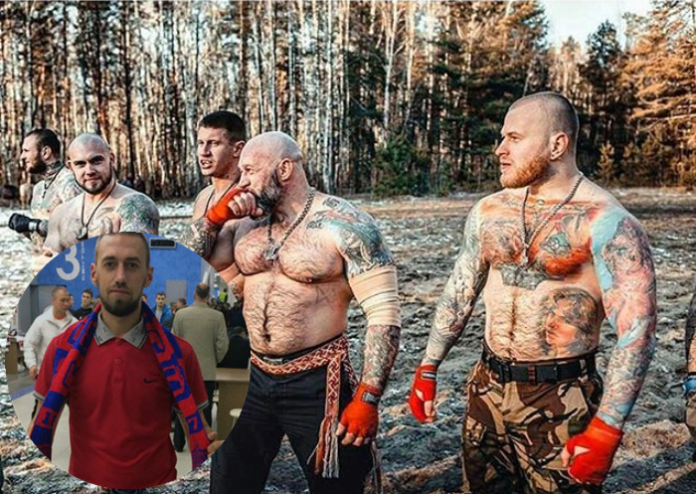
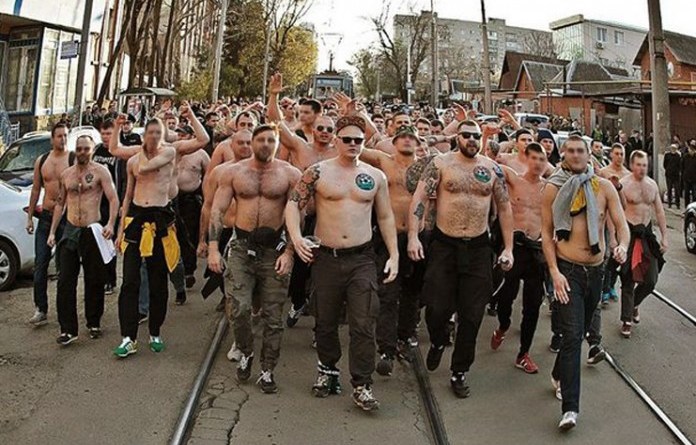
Ludacka akcija navijaca Zenita

Tokom prethodne noci navijaci Zenita odradili su jednu na prvi pogled cestu “navijacku akciju” kada su u Moskvi prekrecili grafite suparnickih grupa. Sve bi bilo normalno da se na udaru nisu nasla cak 33 grafita svih grupa iz Moskve, stradali su grafiti CSKA, Spartaka, Dinama, Lokomotive i Himkija. Poznato je fudbalsko rivalstvo izmedju Moskve i Sant Petersburga koje je vise decenijsko. Kako prenose ruski mediji vise manjih grupa navijaca Zenita tokom noci prefarbali su grafite svih vecih navijackih grupa iz Moskve i na tim mestima napravili svoje grafite. Ovakve akcije postale su sasvim normalne u poslednje vreme i sve vise grupa upada na tudje teritorije i odradjuje svoje grafite, nekada je bilo “populano” skrabanje tudjih grafita ali se to kosilo sa kodeksima pa je sad farbanje i pravljenje novih grafita postalo trend.

Slike ispod pokazuju kako izgledali grafiti pre i posle akcije navijaca Zenita


European Football: The 10 Craziest Ultras Groups

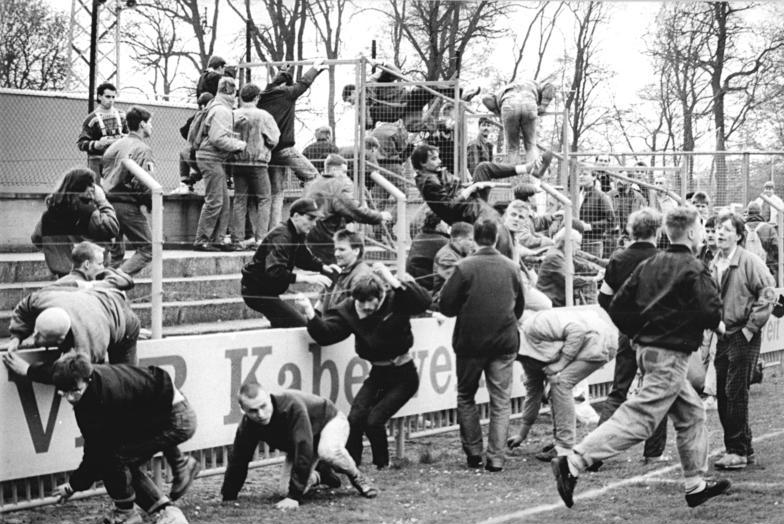
ADN-Pätzold-14.4.90- Schwerin: Leipziger Fans machten sich vor der FDGB-Pokal-Begegnung zwischen dem 1. FC Lok Leipzig und Dynamo Schwerin auf ihre Weise "warm". Die Welle der Gewalt auf den Fußballplätze und nach den Spielen ufert offenbar weiter aus.

There's one thing that sets European football apart from sports in the US, or even football in the UK—the Ultras.

Ultras are the fans who are inevitably the craziest, the most extreme, the most passionate and quite often, the most violent.

But out of all these groups, who are considered to be the best? Who, in a sense, are the ultras among the Ultras?

A club known more for the politics of their supporters than anything else, St.Pauli's Ultras are recognised throughout Europe for their left-wing stance, claiming to stand against “racism, fascism, sexism and homophobia.”

Perhaps unsurprisingly then, St. Pauli have more female followers than any other club in Germany, and have become something of a worldwide brand, with members of music groups such as Sigur Ros, The Gaslight Anthem and Asian Dub Foundation known to sport St. Pauli gear on stage.

Saint Etienne
In France, no Ultras are really capable of matching those of OM—that is, apart from Saint Etienne.
Despite having pretty limited success since the 1970s, when they were among the best clubs in Europe and reached two European Cup finals, the Ultras of les Stéphanois remain fiercely loyal.
The intense atmosphere at Stade Geoffroy Guichard, or “le Chaudron” as it is known, makes it a difficult trip for any visiting team, and their displays and pyrotechnics are up there with the very best.

APOEL

You haven't heard of APOEL? Forgivable. But rest assured, if you ever go to one of their matches or even if you just see the sheer numbers of supporters they take to away games in the Champions League, you won't forget them in a hurry.
They're from Cyprus—so why the Greece flags? Well, as is the case for many Ultras in Europe, politics and football have a tendency to become intertwined. APOEL fans are largely of the belief that Cyprus should be under Greek rule, and make this pretty clear with their displays during games.

Legia Warsaw

OK, so it's true that pretty much all of the Ultras groups in Poland have a reputation for being more than a little bit intimidating. But Legia's Ultras, with their penchant for violence, unswerving loyalty to the team and strong right-wing politics should probably be considered the craziest.
In short, not the sort of fans you want to come across when you find yourself walking down a dark alley toward the stadium…

Ajax
Ajax is a club better known for its conveyor belt of talent, or for being the home of Total Football.
But it might be an idea to add their Ultras to that list.
It's worth pointing out though that their controversial displays of Israel flags at games have nothing to do with their fans political leanings. Often the target of anti-Semitic abuse from other sets of supporters, Ajax fans decided to embrace this, and a number of their Ultras are even known to refer to themselves as “Jews,” even if they have come under criticism from other supporters for doing so.

Napoli
Italy was the birthplace of the Ultras movement, and historically speaking, Napoli's fans were among the front-runners, being the first supporters in Italy to use firecrackers inside the stadium.

Today, Napoli fans remain among the most passionate in the world, boasting the fourth-biggest support in the whole of Italy, but their reputation has been sullied recently with reports of knife-wielding gangs attacking fans of visiting teams, particularly in European competition

Red Star Belgrade

Roughly translated into English as “heroes,” Red Star Belgrade's Ultras, “Delije” are known for their proudly Serbian nationalistic stance, and their “Orthodox brotherhood” with the supporters of Olympiakos and Spartak Moscow.
In fact, many believe that it was the riot that took place after a match between Red Star and Dinamo Zagreb that sparked the conflict in the Balkans. Many of “Delije” were also members of “Arkan's Tigers,” a paramilitary group responsible for the slaughter of a considerable number of Croatians during the war.

Dinamo Zagreb<

While Red Star's supporters were fiercely patriotic about Serbia, Dinamo Zagreb's Ultras felt much the same way about Croatian Independence, supporting Franjo Tudman, who later went on to become Croatia's first President. Things turned sour, however, and the fans were furious when Tudman decided to change the name of the club to Croatia Zagreb, a name which he felt better reflected their patriotism.
Also, don't let the name fool you, the “Bad Blue Boys” are possibly the most dangerous Ultras in Europe.

Hajduk Split

When Dinamo Zagreb fans aren't too busy hating Red Star, most of their attention is focused on their rivals from the south of Croatia, Hajduk Split.
And their Ultras, the “Torcida.”
Taking their name from the most passionate groups in South America, the Torcida like to claim they are Europe's oldest Ultras group, and have the support of a whole region behind them—travel anywhere throughout Dalmatia, and you can expect to see Torcida or Hajduk graffiti daubed over walls and any other available surface.

Olympique De Marseille

It's difficult to pick out a number one Ultras group. When you think about it, there are just so many intangibles to be taken into consideration and at the end of the day, a lot of it is simply a matter of opinion.
That said, if you're going to pick one, it's hard to look beyond those of Marseille
Known for being among the most passionate supporters in the world – if not the most – the displays from the fans are beyond compare, and the atmosphere at the Vélodrome for big matches (especially those in the Champions League or against PSG) is unrivaled anywhere else in Europe.
Setting foot inside the city for any amount of time will almost immediately give you an idea of just how much their team means to the people of the city.

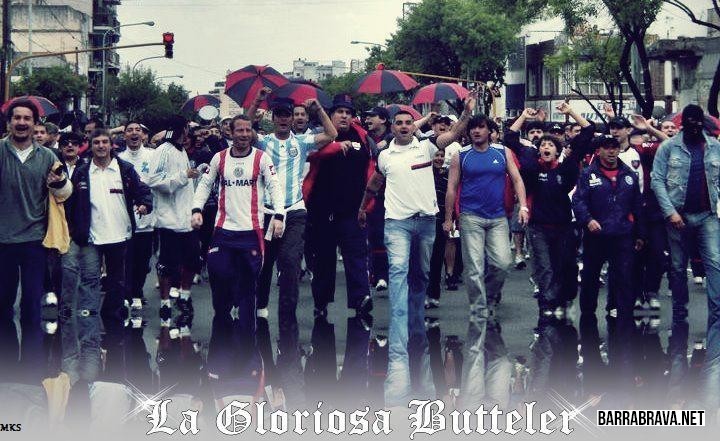
ARGENTINSKA GRUPA: La Gloriosa Butteler, San Lorenzo, Buenos Ajres

Navijačka scena u Argentini je apsolutno bez premca, kako u pozitivnom tako i u negativnom smislu. Kada se gleda iz ovog prvog aspekta, većina neupućenih navijača odmah pomisli na River i Boku, međutim jedan klub je verovatno i ispred njih – San Lorenco. Klub iz predgrađa Buenos Ajresa ima fanatične navijače koji nose naziv La Gloriosa Butteler (Slavni trg Buteler).

Ime su dobili po malom trgu u predgrađu Bodeu gde su se okupljali pre svakog meča. Kada je osnivana barra brava 1988. godine i kada je pravljena prva zastava, rešeno je da zbog te tradicije ona treba da ponese ime po trgu. Ime su izgradili velikom privrženošću, gromoglasnim pevanjem, trenutno najboljim u Argentini, inovacijama i naravno spremnošću na huliganizam. Ipak, način na koji podržavaju ekipu pesmom je zaista vanserijski.

Prvi i najveći naprijatelji su im navijači Boke i Urukana, dok su nivo ispod, barem kako oni sami kažu fanovi Rasinga, Independientea, Veleza, Rivera i Njuelsa. La Gloriosa Butteler je u dobrim odnosima samo sa navijačima niželigašima Taljeresa i Uniona.

Grupa se ponosi gostovanjem u Rosariju 1995. kada je putovalo 30.000 navijača. Koliki uticaj imaju na klub govori činjenica da su 2006, kada je argentinski savez doneo odluku da se celo kolo igra pred praznim tribinama, oni zabranili igračima da igraju i San Lorenzo je bio jedini klub koji to kolo nije odigrao.

Navijači San Lorenza hoće da se njihov klub vrati u stari kraj Boedo, deo Buenos Ajresa gde je 1979. godine srušen stadion ove ekipe. Čak 15.000 navijača sakupilo se ispred parlamenta kako bi pružilo podršku predlogu zakona koji bi im omogućio da se stadion ponovo podigne na mestu nekadašnjeg objekta. Kada to nije pomoglo čak 110.000 njih se skupilo na trgu Majo u Buenos Ajresu.

San Lorenzo je iseljen iz Boeda 1979. godine kada je klub zbog dugova morao da proda stadion Gasometro i okolno zemljište i da se preseli na novu lokaciju. Na mestu nekadašnjeg stadiona nalazi se hipermarket, iako je prvobitno bilo predviđeno da se grade socijalni stanovi.

Navijači San Lorenca nikad se nisu navikli na novi stadion na koji su se preselili 1993. godine, a najveća zamerka je što se objekat nalazi blizu siromašnih četvrti grada.

Navijači San Lorenza su izuzetno privrženi svojim igračima i čuvaju ih u svakom trenutku. Kada je na meču Klausure između Veleza i San Lorenza golman Pablo Miljiore pogođen predmetom bačenim od strane fanova Veleza, pristalice njegovog tima pokušale su da pokidaju ogradu i da napadnu fudbalere domaćih. Arbitar je zaustavio utakmicu, a samo nekoliko minuta kasnije je i definitivno prekinuo posle savetovanja sa policijom. Pripadnici snaga bezbednosti su saznali da je Ramon Aramaja, fan San Lorenza, preminuo pod nerazjašnjenim okolnostima. Ili ga je pogodila policija ili je doživeo srčani udar ili je pogođen kamenom.

Kada se San Lorenzo na kraju prošle sezone borio za opstanak, sudija koji je napravio kardinalnu grešku na štetu ovog kluba stadion je morao da napusti pod pratnjom specijalaca, ne bi li izvukao živu glavu.

Napad Manijaka na korteo Hordi Zla (VIDEO)

Nekoliko Manijaka napalo je juce korteo Hordi Zla koji se kretao ka Grbavici na derbi izmedju Zeljeznicara i Sarajeva. Manijaci su sa bakljama pokusali da dodju do Hordi u cemu ih je sprecila policija, medjutim nekolicina ljudi iz kortea je ipak uspela da se otrgne iz policijskog obruca i dodje do Manijaka koji su nakon razmene nekoliko udaraca pobegli. Sarajevski derbi nije odigran juce zbog losih vremenskih uslova i nemogucstva uprave Zeljeznicara da pripremi adekvatne uslove za odigravanje utakmice po snegu. Posle jucerasnjeg odlaganja utakmice ona ce biti ponovljena danas , sve kupljene ulaznice od juce vazice i danas. Ovaj derbi bice veoma zanimljiv jer eventualnom pobedom Zeljeznicar isbija na deobu prvog mesta na tabeli, a ukoliko Sarajevo bude bolje ukljucuje se u ozbiljnu trku za prvo mesto.

https://www.youtube.com/watch?v=SlTUNjOQTxE&feature=youtu.be

Veliki obracun navijaca u Bugarskoj i Grckoj (VIDEO)

Na danasnjem derbiju bugarske prve lige izmedju Lokomotive iz Plovdiva i CSKA iz Sofije doslo je do velikog obracuna navijaca dveju ekipa. Navijaci gostujuce ekipe probili su zastitnu ogradu i sukobili se sa navijacima domace ekipe koji su imali pomoc navijaca Spartaka iz Moskve. Posle sukoba 10-ak navijac je privedeno na obe strane…

https://www.youtube.com/watch?v=MlLLtELcsSk


U Atini je danas doslo do sukoba navijaca PAOK-a i migranata iz Pakistana koji su obelezavali dan proroka Muhameda, vise osoba je povredjeno u okrsaju dveju strana. Inace PAOK je danas gostovao Panioniosu dok su Pakistanci proslavljali na trgu. Deo PAOK-ovih navijaca je ultradesnicarski orijentisano i dosta njih su pripadnici radikalnih grckih pokreta…

https://www.youtube.com/watch?v=bXbQNV0q7D4

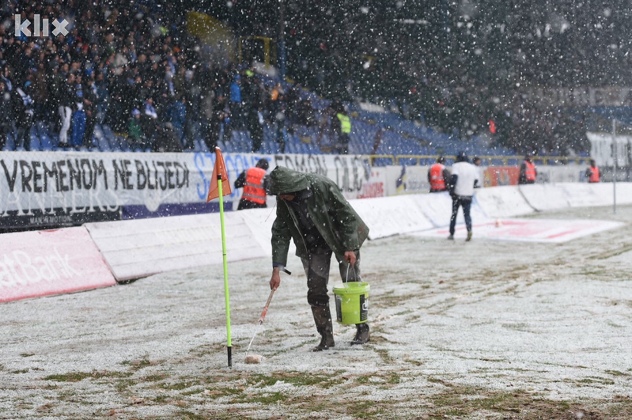
(VIDEO) Lopte farbane sprejom, teren na Grbavici čišćen s dvije lopate

Današnji susret 16. kola Premijer lige Bosne i Hercegovine između Železničara i Sarajeva na Grbavici nije odigran zbog nepostojanja minimalnih uslova.

Susret je trebao početi u 13 sati, ali kada je glavni sudija Irfan Peljto zajedno sa kapitenima ekipa Vedranom Kjosevskim i Markom Mihojevićem izašao na teren, ustanovljeno je da ne postoje uslovi za igru.

Nakon dvadesetak minuta ponovo jer sarajevski arbitar pozvao kapitene timova da provjere da li su stečeni minimalni uslovi za igru, ali i tada je bilo jasno da se lopta ne može ni kotrljati, te je susret odgođen, a prema pravilima trebao bi biti odigran sutra u 13 sati.

Od jutros je u glavnom gradu BiH padala kiša, koja se oko podneva pretvorila u snijeg. No, unatoč vremenskim neprilikama, organizator utakmice FK Željezničar nije učinio skoro ništa da se pokušaju steći minimalni uslovi.

S obzirom da je za danas najavljen snijeg, ljudi zaduženi za održavanje terena na Grbavici su trebali pripremiti “zimsku opremu” koja podrazumijeva markiranje golova crvenim trakama, obilježavanje terena crvenim linijama, redovno čišćenje terena, donošenje crvenih/narandžastih lopti… Ništa od navedenog nije urađeno na Grbavici danas.

Samo jedan čovjek je uzeo lopatu u ruke, a tek iza 13 sati je dobio pomoć još jednog čovjeka. Dakle, Željezničar ima dvije lopate za čišćenje terena.

Također, kasno je počelo “ispravljanje” bijelih linija, a najveći podsmijeh širom regije izazvalo je rješenje za loptu.

Naime, bijele lopte su prefarbane crvenim sprejom, a i sami možete vidjeti na šta to liči.

Svakako da stanju terena nije pomoglo ni to što su juniori Željezničara u srijedu igrali utakmicu protiv Lokomotive, te dodatno izrovili teren.

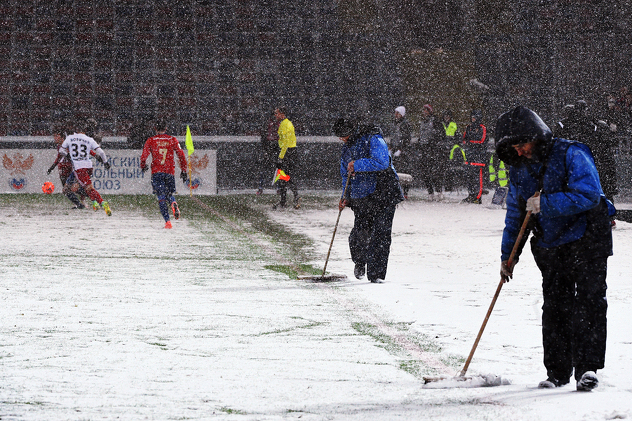
Kako se postupa u ovakvim situacijama najbolje možemo vidjeti u Rusiji, gdje su svi gorenavedeni uslovi ispunjeni, a uz to tokom susreta ljudi redovno čiste aut linije.

Sve u svemu, iz haotične pripreme za današnji meč na Grbavici treba izvući pouke koje se više ne smiju dešavati na našim terenima.

U organizovanom sukobu, ubijen navijač u Rusiji.

Huliganizam će biti jedna od najvećih prijetnji normalnom održavanju Svjetskog nogometnog prvenstva u Rusiji, a koliko je problem ozbiljan pokazuje i vijest koja danas stiže iz zemlje domaćina SP-a, tjedan dana prije ždrijeba.

Ruski mediji javljaju kako je navijač drugoligaša Jeniseja iz Krasnojarska Eduard Samiškin ubijen u Novosibirsku uoči utakmice protiv Sibira. Po pisanju lokalnih medija, došlo je do organizirane tučnjave dvaju navijačkih skupina kakve su u Rusiji uoči utakmica velikih rivala već dio folklora, a u brutalnom obračunu s više desetaka ozlijeđenih smrtno je stradao 30-godišnji gostujući navijač. Razlog dogovorene tučnjave je ukradena zastava i transparenti u nedavnoj utakmici istih suparnika.

Po riječima svjedoka, smrskana lubanja nakon što je ozlijeđen pao na zemlju i nije se više mogao braniti, a ozlijede su bile tako teške da ga liječnici nisu mogli spasiti iako je hitno prevezen u bolnicu.

Tragično preminuli navijač je iza sebe ostavio ostavio suprugu i sinčića.

Crna je to najava Svjetskog prvenstva u zemlji čiji su navijači ostavili krvavi trag i na dva zadnja Europska prvenstva, ponajviše u sukobima s ‘tradicionalnim neprijateljima’, huliganima iz Njemačke i Engleske.

History’s Top 15 Worst football tragedies

There are a lot of soccer stadium disasters in the history of the sport. This is probably due to the fact that football is the most popular sport in the world. Hooliganism may play a small part in some, but we think the problems are mostly because stadiums are old, and they can’t keep up with the increasing amount of spectators. There is usually no orderly or logical setup for efficiently moving people inside them. It’s basically a free-for-all, and if the match is big enough, that could end in tragedy.

15. Burnden Park Disaster
Date: 9 March 1946
Location: Burnden Park, Bolton, Manchester, England
Death Toll: 33

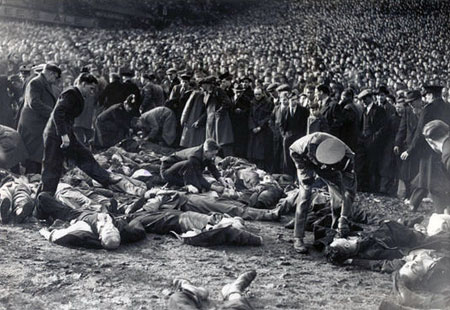
At Burnden Park, a game between the Bolton Wanderers and Stoke City was taking place when a wall collapsed, crushing spectators and starting a stampede which killed 33 people. More than 400 others were injured. The crowd was more than 85,000 people. The tragedy was thought to have started when some 20,000 fans locked outside broke down the gates and forced their way in. At the time, this was the biggest tragedy in British football history, until the Ibrox Park disaster at Rangers’ home ground in 1971 (see #8 below).

14. The Heysel Disaster
Date: 29 May 1985
Location: Heysel Stadium, Brussels, Belgium
Death Toll: 39

Hooliganism was the trigger for this tragedy among the worst soccer disasters. Back in 1984, when Liverpool F.C. (England) defeated Roma, the Liverpool fans were attacked by the Roma fans. So there was already bad blood between England and Italy when Liverpool faced off against Italy’s Juventus F.C. the following year. As for Heysel Stadium, it was old and outdated. Build in 1930, parts of the stadium were crumbling. But the 1985 European Cup Final was played there anyway, and about 60,000 fans crammed in the place.


About an hour before kickoff, Liverpool fans broke through a fence and attacked Juventus supporters. The Italian fans retreated, but there was a wall behind them, which soon collapsed. The retaining wall collapse killed 39 people and hurting hundreds more.

Juventus fans then started to riot, fighting against police with rocks and bottles. The game was still played despite what was going on, with Juventus eventually winning 1-0.

After the disaster, all English football clubs were placed under indefinite ban by the UEFA from all European competitions (lifted in 1990-91). The disaster has been called “the darkest hour in the history of the UEFA competitions.”

In 1995 the Heysel Stadium was demolished and the King Baudouin Stadium built in its place.

Trivia: the disaster was the subject of a song titled “38” by the group Revolting Cocks.

13. Orkney Disaster
Date: 13 January 1991
Location: Oppenheimer Stadium, Orkney, South Africa
Death Toll: 42

South Africa is not immune from some of the worst soccer disasters. In the mining town of Orkney, during a pre-season game between the Kaizer Chiefs (the South African football club, not the British band!) and the Orlando Pirates, (from the township of Orlando in the South African city of Johannesburg, not the Florida town where people go to see Mickey Mouse!), 42 people died in a stampede after a Pirates fan attacked Chiefs supporters in the crowd with a knife. (They called the match a “friendly” – we’d hate to see what an unfriendly game looks like!) Most of the victims were trampled along riot-control fences that surround the field when panic set in and people tried to get away.

12. Ellis Park Stadium Disaster
Date: 11 April 2001
Location: Ellis Park Stadium, Johannesburg, South Africa
Death Toll: 43

The lesson of the Orkney tragedy was not learned. Ten years after that event, on April 11th, 2001, spectators poured into the Ellis Park Stadium for another match between the Kaizer Chiefs and Orlando Pirates. There was already a 60,000 capacity crowd in the stadium, but reports suggest a further 30,000 fans were still trying to gain entry to the stadium. Reports also suggest that 120,000 fans were admitted.

As the crowd surged to gain seats, they spilled into the press boxes. The resulting stampede crushed 43 people to death. Apparently untrained security guards fired tear gas at the crowd, making the situation worse.
When it became apparent what had happened the match was halted and the crowd was dispersed. It was the worst sporting accident in South African history, beating out the Orkney incident by just one body. Hopefully, these two teams will stop trying to break their records.

11. Kayseri Ataturk Stadium Tragedy
Date: 17 September 1968
Location: Kayseri Ataturk Stadium, Kayseri, Turkey
Death Toll: 44

The match: Kayseri Erciyesspor Turkish Sports Club vs Sivasspor Turkish sports club. Victims were caught up in rioting following incidents on the field between fans from neighboring Sivas and the home crowd from Kayseri. 44 were killed and 600 injured. Apparently, guns, knives, and other weapons were used.

From Soccer and Disaster: International Perspectives (Sport in the Global Society) by Paul Darby:

The Kayseri vs. Sivas football disaster is perhaps one of the most defining events to affect Turkish society during the late 1960s. Football teams were more than tools in the challenge of the provincial cities to Istanbul’s hegemony. They also contributed to symbolic forms of rivalry between the mid-sized cities, which competed to be regional centres. Conflict was more intense between cities like Kayseri and Sivas. Kayseri was more developed and wealthier than Sivas. Moreover, merchants of Kayseri origin dominated the economy of Sivas. Therefore, while football matches represented for Sivas the idea of challenging the traditional hegemony of Kayseri, for Kayseri it meant resistance to this challenge. Prompted by this strained social and economic background, several fights broke out between the amateur teams of Kayseri and Sivas.

Nearly 21,000 people attended the first league meeting between Kayserispor and Sivasspor. As the level of tension during the match escalated, fans began to throw rocks at each other. A group of people on the Sivas side, seeking to escape from the rocks, rushed toward the field and the exit gates. Those who tried to enter the field were met by police batons and turned back. In a panic, thousands of Sivas fans pressed towards the nearest gates, crushing their fellow supporters against the fencing at the front of the terrace. When the human wave drew back, the scene was horrific: 40 people were dead and at least 300 were injured.

As the violence on the ground grew, the referee cancelled the match. The players of both teams fled into the dressing rooms in fear of their own lives. All of the members of the Sivas team were locked in their dressing room and a policeman was charged with guarding them. Yusuf Ziya Özler, one of the of Sivasspor players, is sure today that if the Kayseri fans had seen that only one policeman was guarding the team, they would have been killed mercilessly. Once the Sivas fans had made their way out on to the streets, they destroyed around 60 private cars and the city’s gymnasium. They then left Kayseri in a convoy, but 50 kilometres out on the Kayseri-Sivas highway they stopped and began to set fire to cars, buses and trucks whose license plate numbers indicated that they were from Kayseri.

10. Bradford City Fire Disaster
Date: 11 May 1985
Location: Valley Parade Stadium, Bradford, England.
Death Toll: 56

Fire, this time. It broke out during a match between the home team (Bradford City), and Lincoln City, on the day that Bradford City were supposed to have celebrated their winning the Football League Third Division trophy.

It is believed that the fire started when a spectator discarded a lit cigarette down a gap at the back of a terrace seat, which fell onto a pile of trash that had been accumulating under the wooden stand for approximately 20 years.

Five minutes before half-time, white smoke was seen rising from the rear of the 77-year-old stand. The police began to move fans away. Flames emerged from the stand 3 minutes later, and the referee Don Shaw stopped the match. People were evacuated onto the field. The fire rapidly took hold 90 seconds later, with the entire main stand then engulfed within two minutes. Some people seated towards the rear of the stand were trapped in the narrow corridor at the back; most of the fire’s fatalities were found along this corridor where they had been overcome by toxic smoke, by the rear inward opening exit doors and turnstile entrances, which had been locked to prevent unauthorized access after kickoff.

The fire raced along the stand’s wooden roof with wooden boards and hot burning melting tar falling from its roof onto fans below.

56 people died in the fire, and over 450 were injured.

The inquiry into the disaster led to prohibiting the construction of new wooden grandstands at all UK sports grounds. Duh. Wood is a bad idea, ok?

FOX controversially aired footage of the disaster in the program When Good Times Go Bad 3 (Gotta love FOX). They incorrectly blamed supporters for deliberately starting the fire; and the program used punning language such as “as rabid as American fans can get, they can’t hold a candle to soccer fans around the world”. (We have no problem with this statement, because it’s true. However – this is not a good example – the Bradford fire is an unfortunate accident exacerbated by bad stadium design).

The footage of the fire is a sore point with Bradford City people and Yorkshire Television – they will do anything in their power to make sure it stays off YouTube. However, you can find it on WikiLeaks.

Honestly – the video of this event is horrifying. While initially “small”, the fire quickly spreads to the above canopy. From there, it’s only a few minutes before the whole stand goes up. People who made it to the field are actually celebrating the event, like they’re at Burning Man or something. Ironically, they (literally) were.

9. The Second Ibrox disaster
Date: 2 January 1971
Location: Ibrox Stadium, Glasgow, Scotland.
Death Toll: 66

You gotta love a stadium that racks up accidents like some women collect handbags. Before the 1971 disaster, there was the First Ibrox Disaster (where, in 1902, a stand collapsed during a game between Scotland and England, killing 25 people and injuring over 500). Later, in 1961, two people were killed in a crush on the stairway.

Almost ten years later, at a Rangers vs Celtic game, things were still tied 0-0 after about 89 minutes in (welcome to the game of soccer). Then the Celtic took a 1–0 lead and many Rangers supporters left the stadium. As the crowd were leaving the ground, barriers on Stairway 13 gave way causing a massive chain-reaction pile-up of spectators. The tragedy resulted in the loss of 66 lives, including many children. Most of the deaths were caused by compressive asphyxia, with bodies being stacked as deep as six feet in the area. Over 200 other fans were injured.

It should be noted that in the last seconds, Colin Stein scored for the Rangers, tying up the game. (Cuz it ain’t over till it’s over!) Initially there was speculation that the fans who left early turned back when they heard roars from the crowd, colliding with fans leaving the ground when the match ended. The official inquiry into the disaster indicated that there was no truth to this – all the spectators were going in the same direction at the time of the collapse. However the “myth of the Stein goal” became widely believed and repeated for many years later.

8. The Luzhniki disaster
Date: 20 Oct 1982
Location: Lenin Stadium, Moscow, Russia
Death Toll: 66+

The Luzhniki disaster was a human crush at Lenin stadium (now known as Luzhniki stadium) in Moscow, during the UEFA Cup match between FC Spartak Moscow and HFC Haarlem on October 20, 1982. The disaster was initially covered up (for the good of the Soviet people, comrade!)

The number of tickets sold for the match was relatively low, as a result, only the East Stand was open for spectators, and for security reasons only one exit from the stand was left open. Minutes before the final whistle when FC Spartak were leading 1-0, the spectators began to leave the stadium through this only exit. Then during the injury time, FC Spartak scored its second goal (Sergei Shvetsov, who scored, later said: “It would be better if I had not scored it!”), and some fans who had previously left the stand turned back to return to the stadium. The returning fans collided with those who were leaving the stadium. Militsiya guards would not allow those leaving to change course and return to the stadium. A stampede ensued in which many people died or were injured. The official number of dead was 66, although many people including victims’ relatives claim this number to be significantly higher, as many as 340.

Sixteen year old Spartak Moscow fan Andrei Chesnokov, who was to become a professional tennis player, was present at the match:

“Near the end of the match, when the 2-0 goal was scored, it went wrong. On the slippery stairs there were crashes; everybody fell over everybody. It was like a domino-effect. You couldn’t get away, the steel banisters twisted under the weight of the people. They were just crushed to death. I also got trapped, but I managed to escape by jumping over the banister. I could get to safety through a row of bodies. Most were dead but some put their hands out to me to be saved, but they were stuck under the pile of corpses. Downstairs I saw rows of bodies. I alone saw more than a hundred that night.”

The only information about the disaster in the Soviet media was a short article that appeared in the newspaper Vechernyaya Moskva the next day. It said: Yesterday in Luzhniki after the football match an accident occurred. There are some injured among the spectators. (We wonder what they said about Chernobyl – probably something about a minor flu bug and some rare weather phenomenon).

Soviet officials claimed the fans themselves to be responsible. The relatives of the victims were allowed to bury them only after thirteen days. For several years following the tragedy, matches were not held at Luzhniki at the end of October in order to prevent relatives of victims from laying flowers there. It wasn’t until a July 8, 1989 issue of the newspaper Sovetskiy Sport that the disaster was talked about openly. The Haarlem players didn’t even know anything of the tragedy at the time it was happening, and only found out about it seven years later.

NOTE: According to UEFA (and others), “various independent studies have since put the death toll as high as 340”. If this is true, it would make the Luzhniki incident the worst soccer disaster in history, beating out the Lima disaster (see #1). We wonder if we’ll ever know the truth (anybody know?)

7. Puerta 12 Tragedy
Date: 23 June 1968
Location: Estadio Monumental, Buenos Aires, Argentina
Death Toll: 71+

It was River Plate vs the Boca Juniors and it ended in the deaths of at least 71 people and more than 150 injured. The majority of the dead were teenagers and young adults.

Apparently, spectators mistakenly headed towards a closed exit after the match. The fans at the front are crushed to death against the doors by other fans unaware of the closed passageway at the back.

There are different theories about what really happened that day. Some claim that Boca Juniors fans threw burning River flags from the upper tiers of the stadium, causing a stampede of the their own fans in the lower tier. Others say that it occurred after River fans arrived at the Boca Juniors’ section, causing the stampede of the visiting fans. Yet others say that Door 12 was locked or would not open at the time, and the fans in the back did not hear the ones up front telling them to stop coming out. William Kent, River’s ex-president, said that the police were the culprits, since they began repressing Boca Juniors’ fans after these had thrown urine at them from the stands. A few witnesses say that the turnstiles to the exit were blocked by a huge iron pole.

After three years of investigation a government inquiry found nobody guilty. Since the tragedy the gates at El Monumental have been identified by letters instead of numbers. Strangely enough, there does not seem to be a consensus on the number of dead. One site puts it at 71, another at 72, and another at 74.

6. Port Said Stadium Disaster
Date: 1 February 2012
Location: Port Said Stadium, Egypt
Death Toll: 79

Two competing teams – Al Masry and Al-Ahly – competed in a match where Al-Masry won 3-1. These two teams had lots of bad blood between them. Following the victory, thousands of Al-Masry spectators stormed the stands, violently attacking Al-ahly fans, and also the club’s players. They used weapons – knives, clubs, bottles, fireworks, even swords. At least 79 people died and more than 1,000 were injured. See more here and at Wikipedia.

5. The Guatemala Disaster

Date: 16 October 1996
Location: Mateo Flores National Stadium, Guatemala City, Guatemala
Death Toll: 80+

Source: CNN

Scores of people were trampled or suffocated to death when fans trying to jam into a soccer stadium stampeded at a World Cup qualifying match. About 80 people, including children, were killed and about 180 more were hurt.

There were conflicting accounts on what set off the stampede before a scheduled match between the Guatemalan and Costa Rican national teams. Initially, firefighters attributed it to desperate fans trying to claw their way through a concrete passageway into the sold-out stadium. The world soccer association FIFA, however, said forgers apparently had sold fake tickets to the match, bringing far more people to the stadium than could fit.

The bodies of mostly young soccer fans were lined up under coats and blankets in a long row stretching far across the stadium after the match was suspended. The deadly stampede occurred about an hour before the match. One radio report said as many as 60,000 fans may have been packed into the stadium, which has an official capacity of 45,800.

Witnesses said gate-crashers, pushing into the bleachers through a concrete causeway at the south end, overwhelmed fans below, causing a mass of people to tumble down on top of one another. The entrance to the stadium is at street level, and the playing field is dug out below. A brawl between fans in the stands, some of whom had been drinking, apparently contributed to the stampede, said Oscar Mias, a government spokesman. But Alberto Chamale, 46, who said four of his brothers and a niece died in the rush, blamed ticket-takers, who he said continued admitting fans even after bleachers were clearly filled to capacity. “The (Guatemalan soccer) federation is at fault for letting in too many people,” Chamale said.

Victor Hugo Perez, the nation’s top prosecutor said at least 83 people died, most of them apparently by suffocation. The fire department confirmed 78 deaths. Other reports say 84 people died.

4. The Katmandu Disaster
Date: 12 March 1988
Location: National Stadium, Katmandu, Nepal
Death Toll: 93

At least 93 people were killed and 100 more were injured when fans attempted to flee from a hailstorm inside the stadium. Ice pellets rained down on the 30,000 fans watching a match between Nepalese and Bangladeshi teams. Witnesses said screaming spectators rushed to the stadium’s eight exits but found only one open. Police and hospital sources in the city confirmed more than 70 people, including two police officers, were trampled to death or suffocated. Government television reported 73 persons were killed, and witnesses said 20 other bodies were later retrieved by relatives.

Hey, people – Exits are there for a reason – so you can exit the premises. We’re sure that locking them all breaks some kind of fire rule, even in Nepal.

3. The Hillsborough Disaster
Date: 15 April 1989
Location: Hillsborough Stadium, Sheffield, England
Death Toll: 96

At the Hillsborough Stadium FA Cup (Sheffield), police opened one of the main gates which resulted in a huge number of fans entering. The sudden surge crushed many Liverpool fans against the riot fencing.

Before the game started, there was a considerable build-up of fans in the area outside the turnstile entrances. A bottleneck developed; people who had been refused entry could not leave the area because of the crush behind them but remained an obstruction. Security opened a side gate to eject someone, and 20 people rushed in through it. With an estimated 5,000 fans trying to get through the turnstiles, the police opened another set of gates, intended as an exit, but instead there was a rush through in the opposite direction.

Weird News Stories
History’s Top 15 Worst Soccer Disasters
posted by Chris Valentine
AddThis Sharing Buttons
Share to FacebookShare to TwitterShare to PrintShare to EmailShare to More242
Top 15 Worst Soccer Disasters

Entries 1 through 5

5. The Guatemala Disaster

Date: 16 October 1996
Location: Mateo Flores National Stadium, Guatemala City, Guatemala
Death Toll: 80+

Source: CNN

Scores of people were trampled or suffocated to death when fans trying to jam into a soccer stadium stampeded at a World Cup qualifying match. About 80 people, including children, were killed and about 180 more were hurt.

There were conflicting accounts on what set off the stampede before a scheduled match between the Guatemalan and Costa Rican national teams. Initially, firefighters attributed it to desperate fans trying to claw their way through a concrete passageway into the sold-out stadium. The world soccer association FIFA, however, said forgers apparently had sold fake tickets to the match, bringing far more people to the stadium than could fit.

The bodies of mostly young soccer fans were lined up under coats and blankets in a long row stretching far across the stadium after the match was suspended. The deadly stampede occurred about an hour before the match. One radio report said as many as 60,000 fans may have been packed into the stadium, which has an official capacity of 45,800.

Witnesses said gate-crashers, pushing into the bleachers through a concrete causeway at the south end, overwhelmed fans below, causing a mass of people to tumble down on top of one another. The entrance to the stadium is at street level, and the playing field is dug out below. A brawl between fans in the stands, some of whom had been drinking, apparently contributed to the stampede, said Oscar Mias, a government spokesman. But Alberto Chamale, 46, who said four of his brothers and a niece died in the rush, blamed ticket-takers, who he said continued admitting fans even after bleachers were clearly filled to capacity. “The (Guatemalan soccer) federation is at fault for letting in too many people,” Chamale said.

Victor Hugo Perez, the nation’s top prosecutor said at least 83 people died, most of them apparently by suffocation. The fire department confirmed 78 deaths. Other reports say 84 people died.

4. The Katmandu Disaster
Date: 12 March 1988
Location: National Stadium, Katmandu, Nepal
Death Toll: 93

At least 93 people were killed and 100 more were injured when fans attempted to flee from a hailstorm inside the stadium. Ice pellets rained down on the 30,000 fans watching a match between Nepalese and Bangladeshi teams. Witnesses said screaming spectators rushed to the stadium’s eight exits but found only one open. Police and hospital sources in the city confirmed more than 70 people, including two police officers, were trampled to death or suffocated. Government television reported 73 persons were killed, and witnesses said 20 other bodies were later retrieved by relatives.

Hey, people – Exits are there for a reason – so you can exit the premises. We’re sure that locking them all breaks some kind of fire rule, even in Nepal.

3. The Hillsborough Disaster
Date: 15 April 1989
Location: Hillsborough Stadium, Sheffield, England
Death Toll: 96

At the Hillsborough Stadium FA Cup (Sheffield), police opened one of the main gates which resulted in a huge number of fans entering. The sudden surge crushed many Liverpool fans against the riot fencing.

Before the game started, there was a considerable build-up of fans in the area outside the turnstile entrances. A bottleneck developed; people who had been refused entry could not leave the area because of the crush behind them but remained an obstruction. Security opened a side gate to eject someone, and 20 people rushed in through it. With an estimated 5,000 fans trying to get through the turnstiles, the police opened another set of gates, intended as an exit, but instead there was a rush through in the opposite direction.

Fans were packed so tightly in the pens that many died standing up from compressive asphyxia. 95 people died and 766 were injured. The death toll reached 96 when another victim of the crush died after remaining in a coma for almost 4 years.

2. The Ghana Disaster
Date: 9 May 2001
Location: Accra Sports’ Stadium, Accra, Ghana
Death Toll: 126

CNN:

The disaster happened at the end of a match at the Accra Sports’ Stadium between premier league rivals Hearts of Oak and Asante Kotoko. 126 people died and scores of fans were also injured as some 70,000 spectators tried to get out of the stadium after police fired tear gas at soccer fans who were tearing up seats. Ashietey-Odunton said there were reports that all the stadium’s gates were locked at the time of the incident and there was a general feeling was that police had over reacted.

“There was smoke and there was debris, and I counted at least 15 people lying on the floor in one part of the stadium. Some were injured and some were clearly dead.”

Accra Hearts of Oak were leading 2-1 against Assante Kotoko when the tragedy began. Bitter rivalry has long marked games between the teams, and the match was heavily policed. Harry Zakour, chief executive of Hearts of Oak, criticized police for firing up to a dozen teargas canisters in the stadium. “One would have been enough to scare the public,” he said. “It’s a very sad story.”

CBC Sports:

Home town team Accra Hearts of Oak was leading 2-1 against Asante Kotoko with five minutes left when Asante supporters began throwing bottles and chairs onto the field, witnesses said. Police responded by firing tear gas, creating panic in the stands as spectators rushed to escape the gas, witnesses said.

Classic case of the police making things worse.

1. The National Stadium Disaster
Date: 24 May 1964
Location: National Stadium, Lima, Peru
Death Toll: 318

The Lima disaster is the worst soccer disaster in the history of the sport, and we are surprised that there is not more information out there on this particular event. It was a match between Peru and Argentina – an Olympic qualifying match held at the National Stadium in Lima. The rivalry between the two countries was fierce, and when Argentina came out ahead people started looking to roll some heads.

The referee disallowed a Peruvian goal two minutes from time, sparking protests from the fans. Their protests soon turned into a full-blown riot and 318 people were killed in the ensuing violence, with more than 500 major injuries.

From the book Catastrophe! The 100 Greatest Disasters of All Time by Stephen J. Spignesi:

The crowd was at a fever pitch and people lit fires in the stands and broke every window in the stadium. The ridiculously outnumbered police were terrified and reacted by lobbing tear gas grenades into the stands and firing live rounds over the heads of the mob. This not only further infuriated the thousands of angry fans, it caused a mindless panic, which resulted in even more people being crushed to death or being suffocated in the massive throng of rioters.

Thousands rushed the iron doors leading out of the stadium, but, as is the custom during play, they were all locked. An eighteen-month-old girl was crushed to death when her father lost his grip on her. Others choked to death on the thick cloud of tear gas.

The doors were finally broken open and the crowd stormed onto the streets of Lima. Thousands of people then marched to the home of Peruvian president, Fernando Belaunde, demanding that the game be officially declared a draw. The deaths, injuries, terrible violence, raging fires, and the people desperately choking mattered little to an insane mob that was fixated on only one thing: the Peru soccer team must not be judged the loser in the match that had just taken place.

Remember, friends. Soccer can be a matter of life and death. Know your exits and stay away from flames.

Gimme all you money! I’ve got a soccer ball! – Bill Hicks
Intervju sa legendom BBB Vladimirom Galoićem – Dugim

ZAGREB – Stariji intervju sa bivšim istaknutim članom BBB.

Razgovarali: Marko Ivanković, Dinamov Sjever, Tomislav Šurina

Kad je riječ o Dinamovim navijačima, svi će se složit ida samo jedno ime dolazi do izražaja, a to je Vladimir Galoić ili kako ga svi bolje znaju “Dugi s Kozjaka”. Prvi čovjek koji je kao nitko dotad okupio Dinamove navijače oko sebe, koji je organizirano išao na utakmice i gostovanja te pridonio razvoju Dinamovih navijača, kasnije BBB-a. Riječ je o jedinom i istinskom vođi kojeg je naša grupa ikad imala.

Reci nešto o prvim počecima, odlascima na tekme gostovanja, ekipi s kojom si išao, ljudima koje si okupio oko sebe.

-Na tekme sam krenul s dvanaest godina, to ti je bilo ‘74. godine, kad sam prvi put zapalil za Ljubljanu. Naravno, dobil sam poslije porciju od staraca, al’ to se ne računa. I tu negdje ti je sve polako počelo kretati. Te tri godine gdje sam mogel tu sam zapalil i onda smo se polako počeli sastajat. Bili su tu Šime, Štrbec, Žos, Rajko Kurčubić, Primorac, Džebo, i tak smo se skupili. U početku nas je bilo dvadesetak, tridesetak i onda smo lagano počeli ić’ na ova bliža gostovanja: Split, Ljubljana, Rijeka, Osijek, a nakon toga su krenula i Tuzla, Sarajevo, Beograd… U Novi Sad se već išlo u sezoni 78/79, tu su već sve bili fakini sa 17, 18 godina; e tad je to već bila ekipa, tad nas je već bilo dvjesto stalnih plus kaj nas se u Novom Sadu uz Vinkovčane, dečke iz Gradiške i ostalih skupilo dobrih 4-5 tisuća. To su ti bili kao neki prvi počeci, u biti u prvim počecima kad smo išli još na staru plinaru (sezona 77/78), tad nas je bilo 50-60, onda su još bili stariji dečki, mi smo još onda bili klinci 16-17 godina, kasnije smo zapalili u vojsku. Kad smo se vratili iz vojske,&nbsp;ekipa je imala već 20-21 godinu i onda je u biti &nbsp; sve to polako krenulo.

Kako ste djelovali za ono vrijeme kao Dinamovi navijači, gdje ste se okupljali?

Imali samo jedno mjesto, nalazili smo se u pivnici i tu kod stadiona, kod Šarića, u Maksimiru preko puta stadiona prije tekme, ali većinom smo se nalazili kad smo išli van u pivnici na trgu ispod kavane Dubrovnik. Gledaj, prije nije bilo telefona, al’ uvijek se znalo kad se nekaj događa, a kad bi nekaj bilo na brzinu, onda bi kurir, kaj su najčešće bili Ćos, Macko i drugi, dolazili kod nas gore na Kozjak da bi širili informacije.

Kvartovi u Zagrebu, podružnice i gradovi u Hrvatskoj općenito – gdje smo imali najjaču ekipu?

Najjaču ekipu smo u ono vrijeme imali u Vinkovcima, Đakovu, u Gradišci, odnosno u Cerniku, to ti je mjesto od kud su bili Mirka, Zemo i kompanija. Tu je bila najjača škvadra, al’ bila je solidna i ekipa iz Splita, od Parangala pokojnog, njegov stariji brat Tomo, on je veliki Dinamovac, on je bil s nama takoreći od prvog dana i još Brico. To ti je isto jedan Splićanin, Ićo pokojni, njih pet-šest…

A tu, naši zagrebački kvartovi?

Bilo nas je iz cijelog grada, al’ većinom tu iz Dubrave, Maksimira, s Kvatrića… Mi iz Kozjaka smo išli masovno, mi smo bili k'o Turci, divlja horda, od osnovne škole se spuštalo nas dvjestotinjak…

Nabroji nam ljude koji su po tebi zaslužni za razvoj Dinamovih navijača, kasnije Bad Blue Boysa?

Mogu ti nabrojat, al’ ne daj Bože da nekog preskočim… To ti je Ćos, Bruno Široki je došao malo kasnije, Šime, Štrbec, Bango, Špaks, Kija, Pajo, ovi iz Vinkovaca, Duca isto normalno, par godina kasnije su se pojavili Macko, Klokan, Radman,…

Kad je nastalo ime Bad Blue Boys?

-To su vjerojatno izvalili Ićo i Buba na jutarnjem prikazivanju filma Bad Boys 17. 8. 1986. na gostovanju u Splitu.

Autori pjesama BBB-a?

-Pjesmu “Imamo bekove, imamo halfove” je stari Ćiro s Trešnjevke slagao. S njim su to pjevali King Kong, Crni i Pero. Buba je smislio “Bog i konjica”. Pjesme su se sklepale svaki dan po par riječi, onako iz zezancije. Pjesmu “Oj Zvezdo, zvezdana” smo smislili mi, pa ju je Torcida počela kasnije pjevat.

Koji su se ostali sportovi pratili?

-U ono vrijeme najviše smo pratili košarku, Cibonu isključivo, onda smo ti znali skočiti pogledati odbojku, Mladost. Išlo se i na hokej, al’ on dolazi kasnije. Jimmy Heys, Tišma -&nbsp;najviše smo išli zbog njih dvojice, jer su se oni uvijek marali. Išli smo i na neka gostovanja &nbsp;s Medveščakom, u Ljubljanu, u Tivoli, u Jesenice.

Kako se pirotehnika nabavljala u ono vrijeme i je li je bilo?

Bilo je petardi i&nbsp;nešto bengalki, to su nam ovi naši Dinamovci iz Splita slali. Tu su bili još i Hasan i Talijan, oni su uvijek nekaj kemijali. Valjda su išli na trajekte, marisali iz čamca. To ti je bilo, kak’ bi ti rekel, više snalaženje.

Od velike četvorke koju grupu najviše cijeniš i općenito koje ljude iz tih grupa?

Od svih, zbilja jedino kaj mogu reći kak’ je redovito dobival batine, al’ je imal srce potuć’ se i sve – to je ćoravi debeli Pampi. On se stvarno batina nadobival, al’ je… il’ je bil udaren u glavu il’ je imal takvo srce. Činjenica je takva kakva je.

Tko ti je od četvorke bio najbolji?

-Grobari. S njima smo se u biti najmanje sukobljavali, ali oni su bili nekako najžešći. Sjećam se jedne tekme u Zagrebu. Bili su im Pampi, Riki Cigan, Belgija i još neki i tu mi je žao k'o psu kaj mi je Belgija zbrisal. To si u životu neću oprostit, htio sam ga skršit.

Što kažeš za Delije u ono vrijeme?

-Bili su nula bodova, a bilo ih je uvjerljivo najviše. Imali su malu grupu kaj se znala dokazivat, a ostatak su bile nule. Redovno su dobivali porcije od Grobara u Beogradu. Oni su čak i u Splitu kad bi se pojavili redovito dobivali batine.

Što se tiče 80-ih, Torcida uporno sebe stavlja u prvi plan. Koliko ima u tome istine i opženito koliko stoji ona teza hrvatska braža?

-Hrvatska braća? Sad ču ti je reći ovak. To su svi znali, to je bilo moje. Ja sam uvijek rekel da se više volim obračunati s jednog torcidašem, nego s deset Delija. Tu su došli, uvlačili su nam se, žicali lovu i tak. Kad smo došli dolje, cijeli grad na nas, a i dolje su nas žicali pare. To je brdo kokošara, tak je bilo i bit će. Imali su u ono vrijeme, krajem 70-ih dok je bil Dugi, Kule i kompanija, to je bilo par tih dečki koji su bili mrak i koji su bili dobri s nama i tak dalje, a ovo ostalo su kokošari, nula bodova.

Dali si ikad išao na Hajdukove utakmice i gostovanja, jer Torcida uporno govori kako su oni išli s nama, a mi sa njima ne?

– Primjer… HSV-ovi navijači bi ih nalupali nasred Rive da nije bilo nas, pa i navijači Totenhama. Išao sam i na Zvezdu dolje i na Waregem, ne znam što sve ne. Na Hajduk-Torino smo se s njima potukli, jer smo uzimali Talijanima šalove, a oni nama: ” Dajte vamo šalove”, ne damo, mi smo ih uzeli-naši su. Kad sam bio sa njima u Beogradu vidio sam kakvi su zapravo, a imali su par dečki koji su stvarno u redu. Oni su išli u Beograd drhtat, a mi ko’ pitbullovi.

Reci nam za neke zanimljivosti sa suparničkim navijačima?

-Cijeli grad zna kad sam Pampija dofurao kod nas na Kozjak. Prvo smo ga dobro ugozbili, pa smo ga zbombali u birtiji, te je kasnije završio u bolnici.

Dinamovi navijači prije i poslije nastanka imena BBB. Razlike i prednosti?

-Kad su nastali BBB i prije toga, znači do rata to je bilo sve u biti jednako, a poslije su se BBB međusobno zakačili i taj raskol i dan danas traje. Nekad smo svi bili jednaki-ujedinjeni. Znalo se Vinkovčani, Đakovčani dečki iz Cernika… Svi koji su dolazili, svi smo bili jedno, svi smo se znali čak ne po imenima, onda iz viđenja. Tada nije bilo sranja i čim su počele kvartovske spike, ekipe iz kvarta, ovo ono, tu je počelo međusobno i dan danas traje. Znači to je jedna velika mana.

Od ‘86.-‘91. je bilo se isto?

-Dobro, već su od ‘86. pa na dalje počele prve pizdarije. Njih par borilo se za prevlast. Tu je htio i Klokan i Radman i Macko i Hasan,.. Svako je imal svoju grupicu, tu su već počele male trzavice, ne velike, jer još uvijek je bilo nas par starijih pa se nije još toliko raširilo. Kad je počeo rat, mi smo se razišli, pa nas nije bilo jedno dvije godine i nakon toga &nbsp; je u biti nastal taj raspašoj, koji sam ja jedanput probal pomirit i uopće mi je krivo kaj sam probal, jer smo sastančili i ništa postigli. Ja se stari konj maltertiram, pomirim ih, a oni mi se drugi dan tuku, a gore jedan drugog grle i to znamo o kome pričamo, mislim da ih ne treba poimence nabrajat. O tom slučaju svi znamo sve i smatram da jako dobro znamo o kome pričamo.

Bergamo, dali je to ono pravo što si očekivao od BBB na prvom evropskom predstavljanju?

Ja sam uvijek bio ekstremni, ali smatram da je to naše prvo europsko predstavljanje bilo ipak malo pre divlje. Ispali smo engleski huligani, malo je sve to pre ekstremno ispalo. Tam’ je jedan naš dečko zgubil oko. Ušli smo na velika vrata i odmah su nas svrstali u sam vrh europskih huliganskih grupa. Trebalo je malo po malo uči, na finjaka.

Znači, s tvoje strane to je bio i plus i minus?

-Navijanje je bilo mrak, ali ovo drugo pretjerano. Recimo u Budimpešti na Ciboni smo se malo potukli s ruskim vojnicima, mrak, ludnica, ništa s murijom, sve u granicama normale. Tek toliko da se osjeti atmosfera. Gle sad ovo u Mađarskoj na repki, bolje da nitko nije išao, greška, čista glupost. Bez potrebe!

Tvoj prvi odlazak na gostovanje u inozemstvo?

-U Torino s 15 godina, još dok su igrali Claudio Sala, Grazzianni i drugi. Ušetao sam se u autobus sa frajerom kaj je izgledao ko’ da mi je stari, a kad sam došao doma dobio sam poštenu porciju, naravno.

Najmasovnija gostovanja?

-‘79. Novi Sad, ‘82. Split i Osijek, ‘83. Beograd, sve oko nekih deset tisuža. Isto pamtim, čini mi se, negdje ‘76., Senzen je zabio gol, bilo nas je puno, stvarno ne znam otkuda su se svi ti ljudi skupili, poplavili smo Beograd. ‘83. je bilo odlično sa Partizanom na Marakani, kada smo vodili 2:0, a završilo 2:2, to se ne zaboravlja.

Često se kaže da je prije među navijačima postojala čast, što to znači?

-Nekad smo se znali potući jedan na jedan, kao ja u Ljubljani pred Tivolijem. Sjećam se u Beogradu, pred Marakanom sam se tukao jedan na jedan, kad je jedan došao i ubo me s leđa nožem, dan danas imam ožiljak. Bilo je to 80-te kad je Mlinarić zabio gol, 18 godina sam imao. Ja i on solo na šake, a drugi se zaleti i s leđa me pogodi nožem. Tako su se &nbsp; Peki i jedan torcidaš na kolodvoru tukli na šake, mogli smo ga pregazit, ali to je bila čast, samo ruke i noge.

Što kažeš na danas dogovorene šore, sa štangama, palicama i raketama?

-Što se dogovora tiče, slažem se, i mi smo se znali dogovorit, ali dogovori kad nema utakmice, kao oni iskompleksirani Poljaci, to je glupost, čisto divljaštvo. Mi smo čak prije utakmice znali izbjegavat sukobe, jer bi došli gledat utakmicu, to je bit, a poslije utakmice smo tražili frku.

Najluđi likovi među Bad Blue Boysima u tvoje vrijeme?

Jedan od njih zasigurno Buba, bio je divan i krasan čovjek, samo kaj je imao život kakav je imao i cugal je puno. Uvijek je imal neke ideje, kao kad se mrtav pijan penjao po stijenama Kantride, imao je spaljen mozak, ali Toni Frkica mi je bil tri put luđi i uvijek je radil neka sranja. Zato je i imao takav nadimak. Mali je bio genijalac, frku je izmislio tamo di je nije bilo. On je starom maznul dnevni utržak iz birtije, otišao u Beograd, potrošio ga s ekipom i vratio se natrag. Tu je još bio i Grga iz Dubrave, kaj je maznul tri litre konjaka, pa je izgorio iznutra. Ne možeš vjerovat, tri litre konjaka. Doli s Trešnjevke je također bio dobar.

Dinamo kao nacionalni klub, što je to za tebe značilo?

-Deda mi je bio kočijaš i Dinamo mi je bio svetinja onda i danas. To da je bio nacionalni klub govori sve da su i Splićani govorili da navijaju za Hajduk, ali da vole Dinamo, jer je bio i ostao pojam hrvatstva. U ono vrijeme se iz našeg kluba išlo u ustaše, a iz Hajduka u partizane. To svaka budala zna. Torcida neće priznat, ali činjenica je takva kakva je.

Često kažemo da je tribina puna indijanaca, kako ih educirat, kako se to nekad radilo?

-Nekad se radilo tako da su indijanci bili dobro prebijeni, to se rješavalo na brzinu. Grupa mora biti grupa, onda je to čvrsta grupa. Evo ti primjer, dvojicu likova sam stjerao s kolodvora, nisam ih pustio u Rijeku jer su radili gluposti, cijela grupa je ispaštala zbog njih, a bili su pravi Dinamovci, išli su na sva gostovanja. To su ti indijanci, ili se opameti i budi kao grupa ili bježi od nas. Danas treba čvršća ruka na tribini.

Promjena imena?

-Čista glupost i samovolja jednog čovjeka.

13. svibnja'90., tvoje viđenje?

Bilo je dobro, ali je moglo biti i bolje. Da se mene slušalo otpočetka bili bi na jugu, a onda bi bilo svašta.

Tvoje viđenje danas BBB-a, dakle koreografije, transparenti i pirotehnika?

-Gledaj, transparenata je bilo i prije, prvi je donio Bato iz Bitole od 204 metra, on je par puta godišnje dolazio na tekmu, tu su još bili Janjevci s transparentom od 120 metara, ali koreografija i organizacija danas su puno bolje nego prije, što je razumljivo. Ovo danas je mrak, ima osamdeset posto boljih stvari nego što smo mi imali prije. Ovo kaj se danas radi je fakat super i dečki mi se jako sviđaju. Danas je više solucija prijevoza, u naše vrijeme je bila jedna jedina, a to je bio vlak, mi smo bili ko’ u getu. Sjećam se ‘94. kad smo kombijem išli u Split. Mi stari konji i neki mlađi. Mislim na Macka, Čupavog i druge i radili smo što smo god htjeli. Što se pirotehnike tiče, vi mlađi danas lakše nabavljate, prije je bilo snađi se, posudi, sve se svodilo na inprovizaciju.

Tvoj komentar, podgrupa među BBB-ovcima?

-To se nekad probalo, ali nije prošlo. Danas je to neophodno i svaka podgrupa mora imat svoga lidera, vođu. Mora se znati u grupi tko je zadužen za koje stvari. To već Talijani, Francuzi i drugi imaju godinama. Prije je to više bilo po kvartovima, onako kvartovske grupice, danas je to ono pravo i u potpunosti ih podržavam.

Za tebe se kaže da si vođa, čovjek koji je prvi okupio navijače Dinama, dali&nbsp; je to bio gušt ili teret?

-U jednu ruku bio mi je gušt i velika ljubav, nikakav teret. Mislio sam uvijek da je dobro to što radim. Puno sam ja dečki iz raznih dijelova grada pomirio, tako da je to u neku ruku bilo i dobro djelo.

Nadimak Dugi otkuda i zašto?

Stvarno ne znam otkuda, dobro, ja sam oduvijek bio visok i mršav. U kvartu su me svi zvali Gala, ne znam, mislim da mi je netko od starijih navijača dao nadimak, pa se prenijelo na masu. Na kraju se desilo da me svi zovu Dugi, a svi višlji od mene za glavu. To me u nekoliko navrata spašavalo pred policijom. Traže Dugog, a svi oko mene višlji.

Nekada se na tribini nisu znala puna imena i prezimena, vež samo nadimci?

Tako je, znali smo se po nadimcima i iz kojeg si djela grada. Mene su svi znali kao Dugog s Kozjaka, rijetko me tko znao po imenu i prezimenu.

Dali ti dođe nekada da dođeš na sjever i popneš se na štangu?

Pa ja ti se baš i nisam volio penjat na štangu. Uvijek sam bio tu negdje, za podijelit koji šamar, ali danas i nemam neke volje jer sve snimaju, a da ne snimaju podijelio bi rado par šamara.

Za kraj-Vladimir Galoić-Dugi-danas?

-Gledaj, i danas ja odem na tekme naravno manje nego prije, ali Dinamo ostaje ljubav za sva vremena. Nemre se sam tak’ lako zaboravit ono kaj sam s njim proživio. Obitelj je tu i treba mislit na druge stvari, a živce najčešže opuštam odlaskom na ribičiju.

Russian hooligans codex! (rules)

The vast majority of fan groups in Russia have adopted a codex to cope with numerous incidents that often result in fatal outcomes.

In order to avoid such a situation, but the power of a hooligan group came to the fore, Russian fans decided, among other things, not to be beaten while playing a national team, not attacking ordinary fans, or beatting fans who beat the ground during the fight. Russian hooligans have adopted a codex containing 13 rules. Some of them have been applied so far, but now they have been put black on white.

Russian Hooligan Code:
1.  They are only hooligans against each other. It's forbidden to attack ordinary fans.

2.  It is allowed to take cheerleading equipment in the fight, but not mobile phones, watches and similar private things.

3.  In a conflict with the police, he helps the fan, even if he was from the rival camp.

4.  If someone gives himself a fan character, they should not attack.

5.  Never be a woman hit.

6.  There is no fight while playing a national team.

7.  The team is always in charge of the team, regardless of the result.

8.  Always help your brother in the group, no matter what the problem is.

9.  Every fan must go to every hosting they can.

10. There are no mutual battles as European club competitions take place.

11.  Agreed battles can start if the number of participants is the same.

12. When someone falls on the beat, he can no longer be touched.